

Why Does Peristaltic Pump Tubing Wear Out
TROUBLESHOOTING & FAQS
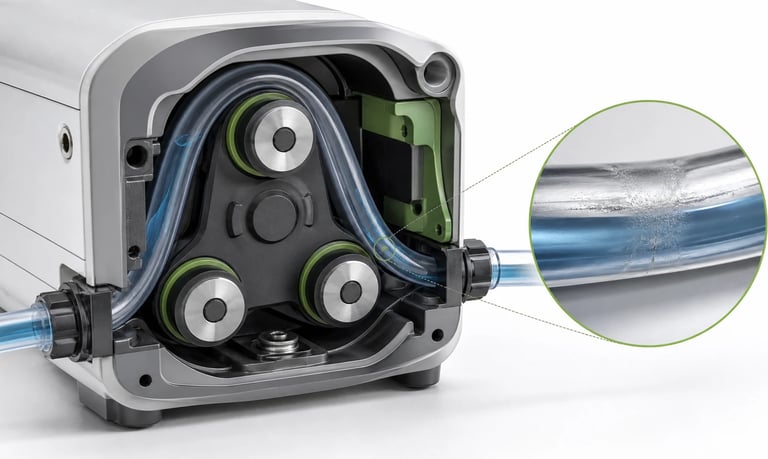
This article explains the main causes of peristaltic pump tubing wear, the warning signs of failure, and practical ways to improve service life through correct tubing, operating limits, installation, testing, and preventive replacement.
Why Does Peristaltic Pump Tubing Wear Out?
Peristaltic pump tubing is repeatedly compressed and released during every rotor revolution. This cyclic deformation makes it a planned consumable rather than a permanent component. Actual life depends on the complete combination of tubing, pump head, liquid, pressure, speed, temperature, and duty cycle.
Mechanical Fatigue
Rollers bend, flatten, and stretch the same tube section thousands of times. Microscopic fatigue damage gradually develops and may appear as flattening, surface wear, cracks, loss of recovery, or leakage.
Higher speed increases compression cycles per hour. Continuous operation can therefore consume tube life faster than an intermittent application with the same calendar age.
Excessive Occlusion
Occlusion is the compression required to close the tube. Too little can allow backflow; too much increases motor load, heat, deformation, and fatigue.
Use the pump-head setting and tube dimensions specified by the manufacturer. Increasing compression to solve pressure or flow problems can shorten life.
Back Pressure
Filters, valves, nozzles, narrow tubing, viscosity, and elevation create downstream resistance. Higher pressure increases stress between rollers and at fittings, and may cause tube swelling or walking.
Measure pressure in the assembled system and test with loaded filters and the actual liquid.
Chemical Exposure
A chemically unsuitable liquid may soften, swell, harden, crack, or permeate the tube. Even a material that appears acceptable during static immersion may fail under repeated pumping.
Verify the exact formulation, concentration, temperature, pressure, cleaning process, and exposure time.
Temperature
Heat can change tube hardness, elasticity, recovery, and chemical resistance. Motor and pump-head heat may make the local tube temperature higher than ambient temperature.
Test normal operation, cleaning cycles, enclosure heat, and storage conditions.
Incorrect Tubing Dimensions or Material
Inner diameter, outer diameter, wall thickness, hardness, tolerances, and fatigue resistance must match the pump head. General-purpose flexible tubing may not be suitable for repeated roller compression.
Use approved tubing and verify performance when changing supplier, formulation, or manufacturing lot.
Installation and Tube Walking
Twisting, stretching, tight bends, poor clamps, misaligned guides, and tension from external tubing can move the pumping segment through the head. This concentrates wear and loads fittings.
Install the tube without torsion, use the specified retention method, and provide a suitable bend radius and service access.
Warning Signs
Flow or dose gradually decreases
Tube remains flattened after the roller passes
Surface becomes cracked, polished, sticky, or discolored
Tube moves through the pump head
Motor current, heat, or noise increases
Fittings become wet or loose
Delivered volume becomes less repeatable
Replace tubing before a predictable wear condition becomes a leak risk.
How to Improve Tubing Life
Select an approved tube material and size.
Use only the required speed and pressure.
Reduce unnecessary downstream restriction.
Maintain correct occlusion and tube retention.
Control temperature where practical.
Flush fluids that crystallize or leave deposits.
Inspect rollers and tracks for damage or contamination.
Calibrate after tube replacement.
Record run hours, cycles, pressure, and replacement history.
Establish a Replacement Interval
Run representative life tests using the actual liquid, speed, pressure, temperature, and duty cycle. Monitor flow drift, tube movement, motor current, temperature, and physical damage.
Test multiple samples and inspect the failure mode. Set the preventive replacement interval before the earliest unacceptable result, using a margin appropriate to application risk.
Frequently Asked Questions
How long does peristaltic pump tubing last?
There is no universal value. Life depends on material, dimensions, speed, pressure, occlusion, chemistry, temperature, and duty cycle.
Does lower speed extend tubing life?
It often reduces compression cycles per hour and dynamic stress, but the benefit must be verified in the application.
Can higher pressure damage tubing?
Yes. It can increase deformation, heat, tube movement, fitting load, and fatigue.
Should tubing be replaced only after leakage?
No. Critical systems should use preventive replacement based on testing, inspection, and performance drift.
Why does new tubing change the flow?
Manufacturing tolerances, elasticity, loading, and break-in behavior affect displacement. Recalibrate after replacement when dosing accuracy matters.
Kamoer Tubing and Pump Support
Kamoer can help evaluate tubing material, dimensions, flow, pressure, speed, duty cycle, installation, and representative life testing for micro and laboratory peristaltic pump applications.
Related Stories
Kamoer Fluid Tech (Shanghai) Co., Ltd.
pump@kamoer.com