

What Is Self-Priming in a Micro Pump
MICRO PUMP BASICS
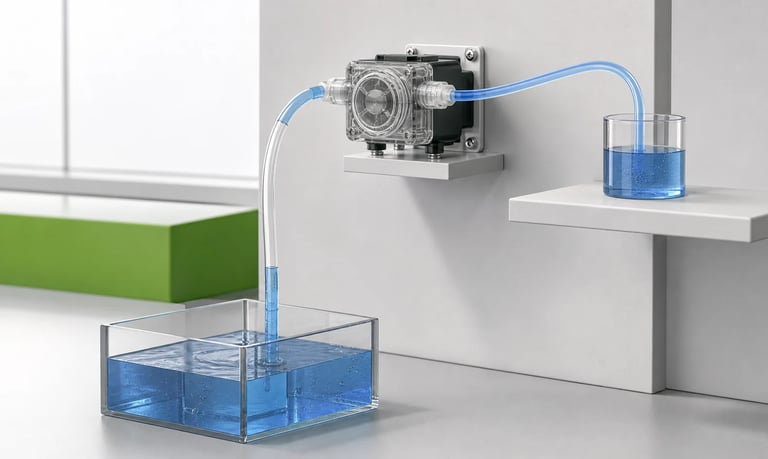
This article explains micro pump self-priming, compares peristaltic and diaphragm priming mechanisms, identifies the factors that limit suction and priming time, and provides practical testing and troubleshooting guidance.
What Is Self-Priming in a Micro Pump?
A self-priming micro pump can remove air from its inlet path and draw fluid into the pump without the inlet line being manually filled first. Self-priming is useful when a reservoir sits below the pump, the line drains between cycles, or equipment must restart after service.
Self-priming does not mean unlimited suction. Priming height, time, and reliability depend on pump design, tubing, valves, speed, fluid properties, leaks, restrictions, and outlet conditions.
How Self-Priming Works
The pump must first move air and lower pressure at its inlet. Atmospheric or reservoir pressure then pushes liquid up the inlet line. After liquid reaches the pumping element, the operating condition changes because liquid is denser and less compressible than air.
A pump may move liquid well after priming but struggle to evacuate an empty line. Priming performance should therefore be specified separately from normal liquid flow.
Peristaltic Pump Priming
Rollers close the flexible tube and move trapped air toward the outlet. As the tube recovers behind a roller, its internal volume increases and creates suction.
Priming depends on complete occlusion, tube elasticity, recovery, pump speed, suction height, and inlet sealing. Worn, flattened, swollen, or incorrectly sized tubing may reduce vacuum and delay priming.
Diaphragm Pump Priming
A diaphragm expands the pump chamber during the suction stroke. The inlet valve opens and air is drawn in. During discharge, the inlet valve closes and the outlet valve releases the air. Repeated cycles evacuate the inlet line until liquid reaches the chamber.
Valve sealing is critical. Particles, deposits, damaged valves, or inlet leaks can prevent sufficient vacuum from developing.
Factors That Affect Priming
Vertical Suction Height
Greater height requires a larger pressure difference and more time. Measure the vertical distance from the lowest liquid level to the pump inlet, not only tube length.
Inlet Tube Diameter and Length
Long, narrow tubing adds resistance and internal volume. It may slow air removal and restrict viscous liquid after priming.
Air Leaks
Loose fittings, damaged tubing, poor seals, and porous components allow air to enter. A small leak may have little visible effect during liquid transfer but prevent initial priming.
Fluid Viscosity and Temperature
Viscous fluids move slowly through the inlet and create more resistance. Temperature may change viscosity as well as tube and valve flexibility.
Pump Speed
Higher speed can remove air faster, but excessive speed may reduce tube recovery or chamber filling. The best priming speed must be tested.
Back Pressure
The pump must discharge air while priming. A restrictive outlet, closed valve, filter, or pressurized destination can delay or prevent the process.
Bubbles and Volatile Liquids
Outgassing and bubbles can make the transition from air to liquid unstable. System layout, reservoir agitation, and temperature should be reviewed.
Self-Priming vs Suction Lift
Self-priming describes the ability to begin pumping from an air-filled inlet. Suction lift describes the vertical height over which the pump can draw liquid under stated conditions.
Neither value should be confused with inlet tubing length. A long horizontal tube adds resistance and volume even when vertical height is small.
How to Test Priming Performance
Assemble the intended reservoir, inlet tube, fittings, pump, and outlet path.
Use the actual liquid and expected temperature.
Start with a dry or defined empty inlet line.
Set the reservoir at minimum expected liquid level.
Record time until liquid reaches the pump and time until stable outlet flow.
Measure current, speed, noise, and leakage.
Repeat at maximum suction height and outlet resistance.
Test new and aged tubing or relevant valve condition.
Repeat enough cycles to evaluate consistency.
Troubleshooting a Pump That Will Not Prime
Check inlet fittings and tubing for air leaks.
Confirm flow direction and port connection.
Inspect tubing occlusion and recovery in a peristaltic pump.
Inspect filters, valves, and deposits in a diaphragm pump.
Reduce suction height or inlet restriction for diagnosis.
Open or reduce outlet restriction.
Confirm voltage, speed, and motor direction.
Test with a known fluid to separate viscosity and compatibility issues.
Replace worn tubing or approved service parts when indicated.
Design Tips for Reliable Priming
Place the pump close to the reservoir when practical.
Use short, adequately sized inlet tubing.
Minimize fittings and possible leak points.
Avoid high points that trap air.
Provide a priming speed or start-up routine.
Detect empty reservoirs and excessive priming time.
Prevent fluid from draining back when the application requires a retained prime.
Validate after maintenance and tube replacement.
Frequently Asked Questions
Are all micro pumps self-priming?
No. Capability depends on pump technology and model. Confirm the specified medium, height, tubing, and operating conditions.
Can a self-priming pump run dry?
Self-priming requires moving air, but acceptable dry-running duration is a separate model-specific limit.
Why does a pump prime with water but not a viscous liquid?
Higher viscosity increases inlet resistance and slows tube or chamber filling. Temperature and suction height may further reduce performance.
Does a check valve help priming?
It can retain liquid or prevent drain-back, but it also adds opening pressure and resistance. Test the complete system.
Why does priming get worse over time?
Tubing fatigue, valve contamination, seal wear, filter loading, leaks, or chemical changes can reduce suction.
Kamoer Application Support
Kamoer can help evaluate pump type, suction height, tubing, valves, fluid properties, speed, pressure, and start-up control for a self-priming OEM fluid system.
Share the reservoir layout, liquid, required flow, inlet path, and outlet conditions with Kamoer for a pump-selection review.
Related Stories
Kamoer Fluid Tech (Shanghai) Co., Ltd.
pump@kamoer.com