

What Is Flow Pulsation in a Peristaltic Pump
MICRO PUMP BASICS
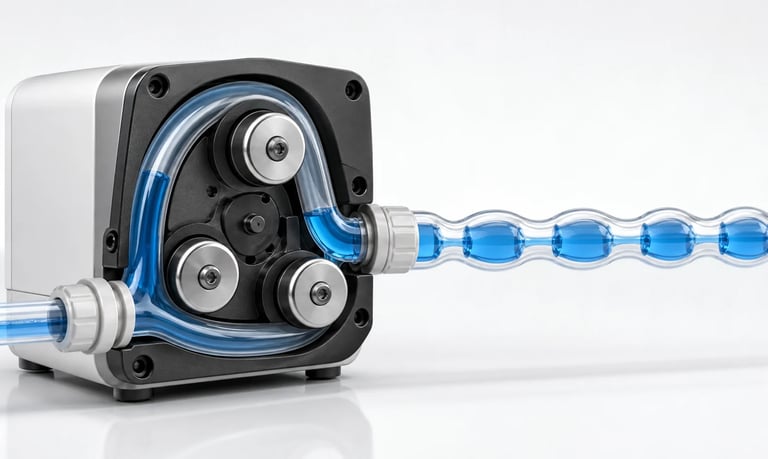
This article explains why peristaltic pumps produce pulsating flow, which pump and system factors change the pulse pattern, how pulsation affects dosing and instruments, and practical methods for measuring and reducing it.
What Is Flow Pulsation in a Peristaltic Pump?
Flow pulsation is the repeated variation in instantaneous flow produced as rollers compress and release peristaltic pump tubing. The average flow may remain stable while the outlet alternates between higher and lower flow during each rotor revolution.
Pulsation is a normal result of the pumping principle, not automatically a fault. Its importance depends on the application. A transfer system may tolerate visible pulses, while an analyzer, spray nozzle, sensitive flow sensor, or precision dosing process may require smoother delivery.
Why Peristaltic Pumps Pulsate
Each roller traps and advances a volume of liquid. When a roller enters the compression track, it displaces liquid. When it leaves, the tube recovers and can briefly change pressure and flow at the outlet. Successive roller events create a repeating waveform.
The waveform is affected by tube elasticity, occlusion, roller spacing, pump-head geometry, liquid compressibility, and downstream compliance.
Factors That Affect Pulsation
Roller Count and Spacing
More rollers generally create more frequent, smaller displacement events, which may reduce the time between pulses. The result still depends on geometry and tube compression. More compression cycles per revolution may also influence tubing life.
Pump Speed
Higher speed increases pulse frequency. It may also make tube recovery less complete, particularly with viscous liquids or restricted inlets. Lower speed can improve smoothness in some systems but does not eliminate pulsation.
Tubing
Inner diameter, wall thickness, hardness, material, recovery, and wear affect displaced volume and pressure response. Aged or chemically changed tubing may produce a different pulse pattern from new tubing.
Back Pressure
Filters, valves, narrow tubing, nozzles, and elevation can increase pulse amplitude or change flow between roller events. Test pulsation at the actual operating pressure.
Fluid Properties
Viscosity, bubbles, temperature, and compressibility influence how rapidly the fluid path responds. Trapped gas can behave like a spring and may either damp or amplify pressure variation.
Outlet Tubing and Components
Flexible tubing and added internal volume can absorb some pressure variation. Rigid short tubing may transmit pulses more directly to sensors or nozzles.
Effects on the Application
Pulsation can cause:
Oscillating flow-sensor readings
Uneven spray or dispensing
Pressure fluctuations
Vibration in tubing and fittings
Variable mixing or reaction conditions
Noise in valves and fluid lines
Dose variation when timing captures only part of a pulse cycle
For timed dosing, repeatability may improve when each dose contains multiple complete roller cycles rather than a small fraction of one cycle.
How to Measure Pulsation
Use a sensor with sufficient response speed and sampling rate. A slow display may show only average flow and miss short peaks.
Record instantaneous flow or pressure together with motor speed, rotor position if available, tubing, fluid, temperature, and back pressure. Evaluate peak-to-peak variation, pulse frequency, average flow, and repeatability over several revolutions.
The sensor itself can change the fluid path. Confirm that its restriction and internal volume are representative of the final system.
How to Reduce Pulsation
Use an Appropriate Pump Head
Compare roller count, phase arrangement, track geometry, and available multi-channel designs. Select from measured performance rather than roller count alone.
Reduce Speed
Using a larger tube at a lower speed may deliver the required average flow with a lower pulse frequency or amplitude. Check dosing resolution, pressure, and tubing life.
Add a Pulsation Damper
A compliant chamber can absorb part of each pressure peak and release fluid between pulses. Damper volume, membrane, gas charge, orientation, and wetted materials must suit the fluid and pressure.
Use Multiple Pump Channels
Two channels operated out of phase can overlap their delivery cycles. This adds mechanical and control complexity but can provide smoother combined flow.
Optimize the Fluid Path
Avoid unnecessary restrictions, trapped air, abrupt changes in diameter, and components that resonate with the pulse frequency. Flexible outlet tubing may provide useful compliance when compatible with the application.
Use Feedback Control
A fast flow or pressure sensor and suitable controller may compensate for some variation. Control bandwidth, sensor delay, and motor response must be considered.
Validation Checklist
Test the actual liquid, tubing, speed, and pressure.
Measure with a sensor fast enough to capture pulses.
Check new and aged tubing.
Evaluate minimum and maximum flow settings.
Test filters and valves in their expected condition.
Observe sensor readings, nozzle output, noise, and vibration.
Confirm that any damper is compatible and cleanable.
Verify dosing over complete and partial roller cycles.
Frequently Asked Questions
Is pulsation normal in a peristaltic pump?
Yes. It results from successive roller compression events. The acceptable level depends on the application.
Do more rollers always eliminate pulsation?
No. More rollers may reduce gaps between delivery events, but tubing, geometry, speed, pressure, and fluid properties still determine the waveform.
Can a pulsation damper improve dosing accuracy?
It can smooth instantaneous flow, but dosing accuracy also depends on calibration, tube condition, control timing, viscosity, and pressure.
Why does a flow sensor reading fluctuate?
The sensor may be detecting real pump pulses. Sensor response, sampling, restriction, bubbles, and installation can also contribute.
Does lower speed reduce pulsation?
It may reduce dynamic effects and improve tube refill, but pulses remain. Test the required flow range in the complete system.
Kamoer Application Support
Pulsation should be evaluated as a pump-and-system behavior. Kamoer can help assess pump-head design, tubing, speed, pressure, control, and fluid-path options for dosing, sampling, and OEM integration.
Share the required average flow, acceptable variation, medium, pressure, and system layout with Kamoer to plan representative testing.
Related Stories
Kamoer Fluid Tech (Shanghai) Co., Ltd.
pump@kamoer.com