

What Is a Diaphragm Pump and How Does It Work
MICRO PUMP BASICS
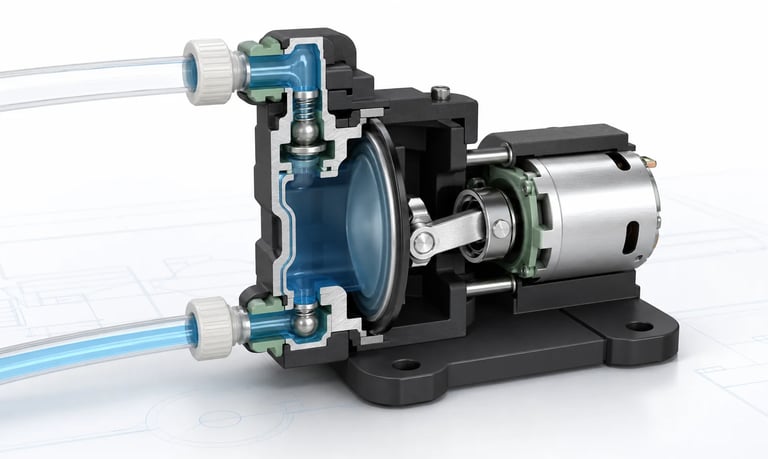
This article explains how diaphragm movement and check valves create suction and discharge, including key components, liquid and gas pump differences, performance factors, applications, selection criteria, and maintenance considerations.
What Is a Diaphragm Pump and How Does It Work?
A diaphragm pump is a positive-displacement pump that moves liquid or gas by repeatedly flexing a diaphragm. The diaphragm changes the volume of a sealed pumping chamber, while inlet and outlet valves control the direction of flow.
When the chamber expands, pressure inside it falls and fluid is drawn through the inlet. When the chamber contracts, pressure rises and fluid is pushed through the outlet. Repeating this cycle produces suction, discharge, and continuous average flow, although the instantaneous flow is naturally pulsating.
Compact diaphragm pumps are widely used in OEM equipment because they can combine a small footprint with liquid transfer, gas sampling, vacuum, or pressure functions. However, liquid and gas models are not automatically interchangeable. Pump structure, valve design, wetted materials, operating point, and system conditions must match the intended medium.
How Does a Diaphragm Pump Work Step by Step?
The basic pumping cycle has two strokes: suction and discharge.
1. The Drive Pulls the Diaphragm Back
An electric motor or another actuator moves the flexible diaphragm away from the pump chamber. As the chamber volume increases, its internal pressure falls below the pressure at the inlet.
The pressure difference opens the inlet valve and draws fluid into the chamber. At the same time, the outlet valve remains closed or restricts reverse flow.
2. The Chamber Fills
Fluid continues entering while the chamber expands. How completely it fills depends on the speed, fluid viscosity, inlet tubing, suction height, valve response, and available inlet pressure.
If the inlet line is too narrow, too long, blocked, or leaking, the chamber may not fill completely before the next stroke. This can reduce flow and cause unstable performance.
3. The Drive Pushes the Diaphragm Forward
The drive mechanism then moves the diaphragm toward the chamber. Chamber volume decreases and pressure rises.
The inlet valve closes to limit backflow, while the outlet valve opens. Fluid is displaced through the outlet and into the downstream system.
4. The Cycle Repeats
Each motor revolution or actuator cycle produces one or more diaphragm strokes, depending on the pump design. Repeated strokes create average flow, suction, pressure, or vacuum.
Because delivery occurs in separate strokes, a diaphragm pump produces pressure and flow pulses. The magnitude of those pulses depends on chamber size, speed, valve behavior, fluid compressibility, tubing elasticity, and downstream components.
Main Components of a Diaphragm Pump
A compact diaphragm pump typically contains several functional parts.
Diaphragm
The diaphragm is a flexible barrier that changes the chamber volume. It also separates the pumped medium from much of the drive mechanism.
Diaphragm material and geometry influence chemical compatibility, displacement, pressure capability, temperature range, fatigue resistance, and service life. Suitability should be evaluated with the actual medium and operating conditions.
Pump Chamber
The chamber holds the fluid during each pumping cycle. Its volume and internal geometry affect displacement, dead volume, flow resistance, and the ability to clear liquid or gas.
For liquid pumps, chamber design can influence bubble handling and residual volume. For gas pumps, it contributes to compression ratio, vacuum, and pressure performance.
Inlet and Outlet Valves
Check valves make the flow directional. They open and close in response to pressure differences during the suction and discharge strokes.
Valve material, stiffness, sealing surface, response time, and contamination condition affect priming, flow, pressure, and leakage. Particles, crystals, fibers, deposits, or chemical attack can prevent reliable sealing.
Motor and Eccentric Drive
Many miniature diaphragm pumps use a DC motor connected to an eccentric cam or crank. Motor rotation is converted into reciprocating diaphragm movement.
Motor type and drive design affect speed, torque, noise, vibration, control range, heat, and service life. Some pumps use brushed motors, brushless motors, stepper motors, solenoids, or piezoelectric actuators.
Housing, Ports, and Seals
The housing supports the chamber and valves, while inlet and outlet ports connect the pump to the fluid path. Seals and joints must maintain pressure and prevent external leakage or unwanted air entry.
In a diaphragm liquid pump, the medium may contact the diaphragm, valve elements, chamber, seals, and port materials. Every wetted component should be included in compatibility review.
Diaphragm Liquid Pumps vs Diaphragm Gas Pumps
Both types use diaphragm movement, but they are optimized for different media and performance targets.
Diaphragm Liquid Pumps
A diaphragm liquid pump is designed to transfer liquids through a chamber and check-valve system. Common functions include water transfer, reagent movement, detergent supply, circulation, dispensing, and drainage.
Liquid pumps must account for viscosity, bubbles, particles, crystallization, chemical compatibility, inlet conditions, and downstream pressure. They may be self-priming under specified conditions, but priming performance depends on the complete system.
Diaphragm Gas Pumps
A diaphragm gas pump is designed to move air or another gas. It can create flow, vacuum, pressure, or a combination of these functions depending on the pump configuration and operating point.
Common applications include gas sampling, air transfer, sensor aspiration, suction, inflation, and pneumatic control. Filters, tubing restrictions, altitude, gas density, leakage, and temperature can influence performance.
Why They Are Not Automatically Interchangeable
Valve geometry, chamber clearance, diaphragm material, sealing, cooling, and rated performance may differ between liquid and gas designs. A gas pump should not be used for unrestricted liquid transfer unless the manufacturer explicitly confirms that capability. Likewise, a liquid pump may not provide the required vacuum or gas-flow performance.
Select the pump category based on the actual medium and required operating point rather than on appearance or motor size.
What Determines Diaphragm Pump Performance?
Published maximum values do not describe every operating condition. A pump works along a flow-versus-pressure or flow-versus-vacuum curve.
Pump Speed and Stroke
Increasing motor speed generally increases the number of pumping cycles per minute. A larger effective stroke can move more volume per cycle. Actual output may become limited by valve response, chamber filling, motor torque, heat, or system resistance.
Inlet Conditions
Long or narrow inlet tubing, filters, elevation, leaks, and viscous fluid can restrict chamber filling. Poor inlet conditions may reduce flow, increase noise, delay priming, or create cavitation-like behavior in liquid systems.
Outlet Pressure
Downstream tubing, nozzles, filters, check valves, and elevation changes create resistance. As discharge pressure increases, flow usually decreases. Excessive load can increase current, heat, vibration, leakage risk, or component stress.
Fluid Viscosity and Temperature
Higher viscosity increases resistance through ports, valves, and tubing. Temperature can change viscosity as well as the flexibility and compatibility of diaphragm and valve materials.
Performance measured with air or water at room temperature should not be assumed to represent every fluid and temperature.
Valve Condition
Reliable valve sealing is essential for suction and pressure. Deposits, particles, wear, deformation, or chemical damage can cause backflow and loss of performance.
Supply Voltage and Motor Control
Voltage, driver behavior, speed control, starting current, and electrical load influence the pump operating point. The pump should be tested with the intended power supply and control circuit, not only a laboratory supply.
Advantages of a Diaphragm Pump
Diaphragm pumps offer several practical benefits for compact equipment.
Compact OEM Integration
The chamber, valves, and drive can be packaged into a compact assembly. This is useful in analyzers, appliances, monitoring devices, cleaning systems, and automated equipment.
Positive-Displacement Operation
Each stroke displaces fluid, allowing the pump to generate suction and work against downstream resistance within its intended range. Actual delivery still changes with pressure, valve behavior, and fluid properties.
Self-Priming Potential
Many diaphragm liquid pumps can draw liquid into an initially empty inlet line. Priming height and time depend on valve sealing, chamber design, speed, viscosity, inlet restrictions, and leaks.
Vacuum and Pressure Capability for Gas Systems
Diaphragm gas pumps can provide vacuum or pressure without exposing the gas to lubricating oil in many compact designs. This can be useful for sampling and analytical systems.
Flexible Control Options
Depending on the motor and electronics, a diaphragm pump may support on-off operation, speed control, PWM, analog control, feedback, or digital communication.
Limitations of a Diaphragm Pump
Important limitations should be included in system design and testing.
The Medium Contacts Internal Parts
Unlike a peristaltic pump, a diaphragm pump normally exposes the medium to the chamber, diaphragm, valves, seals, and ports. Compatibility review is therefore more complex.
Valves Can Be Sensitive to Contamination
Particles, fibers, crystals, dried residue, or deposits may prevent valves from sealing. This can reduce suction, pressure, and flow or allow backflow.
Pulsation and Vibration
Reciprocating diaphragm motion produces pulsation and mechanical vibration. Flexible tubing, compliant mounts, dampers, accumulators, speed changes, or multiple chambers may help, depending on the system.
Flow Varies with System Pressure
Nominal free-flow data should not be treated as the delivered flow at the application's discharge pressure or vacuum. The complete performance curve and intended operating point are more useful.
Wear and Service Life Depend on Conditions
Diaphragms, valves, bearings, motors, and seals experience repeated load. Service life depends on speed, pressure, temperature, medium, duty cycle, mounting, and manufacturing design. Application testing is needed for final validation.
Where Are Diaphragm Pumps Used?
The technology is used for both liquid and gas functions across many industries.
Laboratory and Analytical Instruments
Diaphragm pumps may move reagents, drain waste, circulate liquid, aspirate samples, or draw gas through a sensor. Material compatibility, contamination control, noise, and calibration requirements should be evaluated at instrument level.
Environmental Monitoring and Gas Sampling
Gas pumps can pull air through filters, probes, conditioning components, and analysis cells. Liquid models can transfer water samples, reagents, and cleaning fluids. Field temperature, altitude, filter loading, moisture, and maintenance intervals can affect performance.
Cleaning Equipment and Smart Appliances
Compact liquid pumps can deliver water or detergent, while gas pumps can provide suction or air movement. Noise, vibration, repeated start-stop cycles, leakage protection, and installation orientation are important in finished appliances.
Food and Beverage Equipment
Diaphragm liquid pumps may transfer water, concentrate, cleaning liquid, or other ingredients when the wetted materials and system design are appropriate. Food-contact and regulatory requirements must be confirmed for the specific materials and final application.
Industrial Automation
Automated systems use diaphragm pumps for liquid transfer, chemical addition, cooling, lubrication, gas sampling, vacuum handling, and pneumatic functions. System designers should coordinate the pump with sensors, valves, controllers, and fault logic.
Medical and IVD Equipment
Diaphragm pumps may be integrated as fluid-transfer, aspiration, pneumatic, or sampling components. Use in medical or IVD equipment does not by itself establish medical approval or suitability for a particular regulated function. Final selection depends on system design, documentation, validation, and applicable requirements.
How to Select a Diaphragm Pump
Start by defining the actual working conditions rather than choosing from a single maximum specification.
Define the Medium
State whether the pump will handle a liquid or gas. Provide the chemical name or gas composition, concentration, temperature, viscosity, particles, moisture, volatility, and cleaning method.
Define the Operating Point
Specify the required flow at the expected outlet pressure, inlet vacuum, or system resistance. For gas applications, distinguish free flow from flow at the required vacuum or pressure.
Review Wetted Materials
Identify every material that contacts the medium. Compatibility should be verified under the actual concentration, temperature, pressure, and exposure time.
Define Duty Cycle and Life Expectations
Document continuous or intermittent operation, run time per cycle, starts per day, ambient temperature, mounting, and expected maintenance interval.
Define Electrical and Control Requirements
Confirm voltage, current limits, speed control, start-stop behavior, direction requirements, feedback, communication, and fault response.
Confirm Mechanical Integration
Check dimensions, port orientation, tubing routing, mounting points, isolation needs, heat dissipation, noise, vibration, and access for replacement.
Test the Complete System
Use the actual medium, tubing, filters, valves, enclosure, power supply, and duty cycle whenever possible. Record flow, pressure or vacuum, current, temperature, noise, vibration, priming, leakage, and stability over time.
Diaphragm Pump Maintenance and Troubleshooting
Maintenance needs depend on the model and application, but several checks are broadly useful.
Inspect inlet tubing and fittings for leaks or restrictions.
Check filters for loading or blockage.
Confirm that the supply voltage and control signal are stable.
Look for deposits, particles, crystallization, or dried fluid near the valves.
Monitor flow, vacuum, pressure, current, noise, and temperature for changes.
Verify that mounting fasteners and vibration isolators remain secure.
Follow the manufacturer's procedure for service parts and replacement intervals.
Loss of suction does not always mean the motor has failed. Inlet leaks, valve contamination, blocked tubing, unsuitable viscosity, worn sealing surfaces, or an incorrect operating point can produce similar symptoms.
Frequently Asked Questions
Is a diaphragm pump a positive-displacement pump?
Yes. The diaphragm changes chamber volume during each cycle and displaces fluid through directional valves. Actual flow varies with speed, pressure, valve behavior, fluid properties, and system restrictions.
Can a diaphragm pump move both liquid and gas?
There are diaphragm pumps designed for liquids and others designed for gases. A specific model should only be used with media and conditions confirmed by its manufacturer.
Can a diaphragm pump run dry?
Some diaphragm pumps can tolerate dry operation for a specified period, particularly gas pumps. Acceptable dry running depends on the model, materials, speed, temperature, and duty cycle and should not be assumed.
Is a diaphragm pump self-priming?
Many diaphragm liquid pumps are self-priming within defined limits. Priming depends on valve sealing, suction height, inlet restrictions, fluid viscosity, speed, and leaks.
Why does a diaphragm pump pulsate?
The diaphragm delivers fluid in separate suction and discharge strokes. Chamber size, speed, valve timing, tubing compliance, and downstream components determine the pulse level.
What causes a diaphragm pump to lose suction?
Common causes include an inlet air leak, blocked filter, restricted tubing, contaminated or damaged valves, unsuitable viscosity, incorrect direction, low speed, or worn internal parts.
Kamoer Diaphragm Pump Solutions
Diaphragm pumps provide compact liquid transfer, gas flow, vacuum, and pressure functions for many OEM systems. Reliable selection depends on matching the pump type, wetted materials, operating point, drive, and mechanical integration to the real application.
Kamoer develops diaphragm liquid pumps, diaphragm gas pumps, micro peristaltic pumps, laboratory pumps, and customized OEM fluid-transfer solutions. Kamoer can help evaluate the medium, flow, pressure or vacuum, material compatibility, duty cycle, control method, installation space, and testing requirements.
Looking for a diaphragm pump for an OEM system? Share your medium, required flow, pressure or vacuum conditions, control method, and installation requirements with Kamoer for a pump-selection review.
Related Stories
Kamoer Fluid Tech (Shanghai) Co., Ltd.
pump@kamoer.com