

Silicone vs PharMed vs FKM Tubing for Peristaltic Pumps
TUBING & CHEMICAL
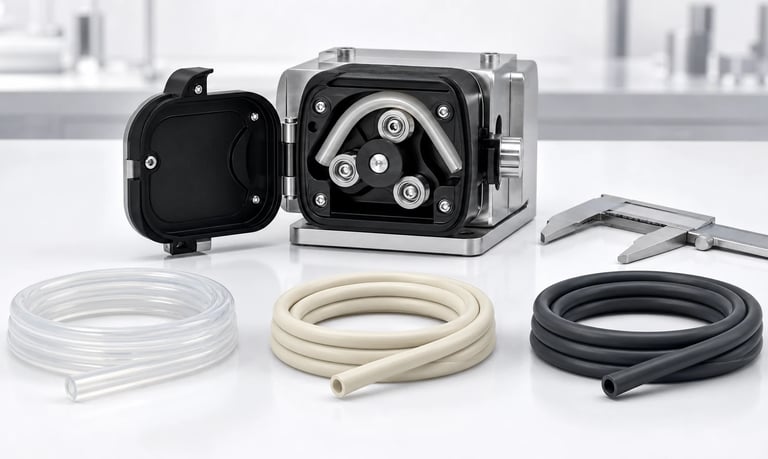
Peristaltic pump tubing selection depends on the exact silicone, PharMed-family, or FKM grade, fluid chemistry, temperature, pressure, flex-fatigue behavior, permeability, cleanliness requirements, sterilization or cleaning process, and representative life testing.
Silicone vs PharMed vs FKM Tubing for Peristaltic Pumps
Silicone, PharMed-family, and FKM tubing are considered for different peristaltic pump applications. They do not offer interchangeable performance, and the material name alone is not enough to approve a tube.
The correct choice depends on the exact tubing grade, dimensions, hardness, fluid chemistry, temperature, pressure, pump head, speed, cleanliness requirements, and expected service interval. Final selection requires supplier documentation and representative pumping tests.
Why Tubing Selection Controls Pump Performance
In a peristaltic pump, rollers repeatedly compress and release the tube. The tube acts as the pump chamber, seal, spring, and only wetted element inside the pump head.
Its properties influence:
Flow per revolution
Suction and tube refill
Maximum practical pressure
Pulsation
Motor load
Dose repeatability
Chemical compatibility
Particle shedding and extractables
Service life
Two tubes with the same nominal inner diameter can produce different flow because wall thickness, hardness, elasticity, surface finish, and dimensional tolerance differ.
Material Names Are Not Complete Specifications
“Silicone” and “FKM” describe broad material families. Formulation, curing system, fillers, hardness, purity, and manufacturing process can vary significantly.
PharMed is commonly used as a product-family name for specialized pump tubing. Different product variants or generations may have different materials, documentation, and performance. Always use the supplier's complete product name and current datasheet.
Do not transfer compatibility, temperature, regulatory, or life claims from one grade to another because the names sound similar.
Silicone Tubing
Silicone tubing is widely used in laboratory, dosing, food-processing, and equipment applications. Its flexibility and elastic recovery can make it suitable for peristaltic compression, and transparent or translucent grades allow visual inspection of fluid and bubbles.
Potential advantages, depending on grade, include:
Good flexibility
Broad availability in sizes and formulations
Visual inspection through translucent tubing
Availability of high-purity or documented grades
Compatibility with some sterilization processes
Limitations can include gas and vapor permeability, swelling or chemical attack with certain fluids, adsorption of some compounds, particle generation, and flow drift under repeated compression.
Do not assume silicone is compatible with every solvent, oil, concentrated chemical, or cleaning agent. Test the exact grade.
PharMed-Family Pump Tubing
PharMed-family tubing is often selected where long flex life, reduced gas permeability relative to some silicone grades, or specialized laboratory and bioprocess documentation is desired. Actual properties depend on the named product and supplier.
Potential considerations include:
Flex-fatigue behavior in peristaltic service
Opacity, which can limit visual inspection
Gas and vapor permeability
Chemical compatibility with process and cleaning fluids
Extractables and application-specific documentation
Sterilization compatibility
Availability in the required dimensions
It is not enough to state “PharMed tubing” without identifying the full grade. Confirm that datasheet conditions match the pump head, tube size, speed, pressure, and temperature.
FKM Tubing
FKM is a fluoroelastomer family considered for resistance to certain fuels, oils, solvents, and aggressive chemicals. Its suitability varies with formulation and fluid chemistry.
Compared with many soft silicone tubes, an FKM tube may be less flexible or require different occlusion and motor torque. Some grades may not recover quickly enough for a given peristaltic speed or inlet condition.
Important checks include:
Exact chemical compatibility
Hardness and compression force
Tube recovery at operating speed
Low- and high-temperature behavior
Flex-fatigue life
Dimensional tolerance
Availability of required cleanliness or compliance documentation
Chemical resistance alone does not make an FKM grade suitable for peristaltic pumping. It must also tolerate repeated mechanical compression.
Compare Chemical Compatibility
Compatibility depends on the exact fluid composition, concentration, temperature, pressure, exposure time, and mechanical stress. Include:
Production fluid
Cleaning and sanitizing agents
Calibration fluids
Rinse fluids
Mixed waste
Foreseeable contaminants
Review supplier data, then pump representative fluid through the tube. Inspect for swelling, softening, hardening, cracking, discoloration, tackiness, mass change, loss of elasticity, and changes in flow.
Immersion testing can reveal chemical change but does not reproduce cyclic compression. Combine chemical exposure with dynamic pump testing.
Evaluate Flexibility and Tube Recovery
After a roller passes, the tube must reopen quickly enough to draw in the next volume of fluid. Recovery depends on material, wall thickness, hardness, temperature, age, inlet vacuum, and pump speed.
Slow recovery can reduce flow, increase pulsation, and make speed-to-flow response nonlinear. This is especially important with viscous fluids, long inlet tubing, restrictive filters, or high pump speed.
Measure flow across the required speed and inlet conditions. Observe whether increasing speed still produces a proportional flow increase.
Understand Flex-Fatigue and Service Life
Peristaltic tubing is a consumable. Repeated compression can cause fatigue, cracking, spalling, permanent deformation, or loss of flow.
Service life is affected by:
Tube material and dimensions
Pump-head geometry and occlusion
Speed and direction changes
Pressure and inlet vacuum
Fluid chemistry
Temperature
Continuous or intermittent duty
Installation tension and alignment
Do not publish a universal life value for a material family. Establish a preventive replacement interval from representative tests using the exact tube, pump head, fluid, and duty cycle.
Account for Temperature
Temperature changes tube flexibility, recovery, chemical compatibility, permeability, motor load, and delivered flow. A tube can become softer, harder, or more prone to permanent deformation outside its normal range.
Check the supplier's limits for the exact grade and application. Include fluid temperature, ambient temperature, enclosure heating, cold startup, and cleaning or sterilization temperatures.
A short high-temperature cleaning cycle and continuous pumping at the same temperature are not equivalent conditions.
Consider Permeation, Adsorption, and Evaporation
Gases, vapors, or liquid components may permeate through elastomer tubing. Oxygen ingress, solvent loss, water-vapor transfer, or odor release can affect sensitive processes.
Fluid compounds may also adsorb onto the tubing or later desorb, creating concentration error or carryover. This can matter in trace analysis, pharmaceutical development, fragrances, and volatile formulations.
Compare complete fluid-path performance using the intended analytical or product-quality method. General material resistance does not prove acceptable permeation or recovery.
Review Cleanliness and Regulatory Documentation
Applications may require information about extractables, leachables, particle shedding, biocompatibility, food contact, or manufacturing traceability.
Requirements vary by market, process, temperature, contact time, and intended use. Obtain current documentation for the exact tubing grade and manufacturing configuration.
Do not assume that all silicone, PharMed-family, or FKM tubing carries the same certifications. Equipment-level compliance remains the responsibility of the final manufacturer.
Check Sterilization and Cleaning Compatibility
Steam, radiation, chemical disinfectants, alcohols, oxidizers, detergents, and repeated cleaning cycles can change tube properties. A tube that tolerates one exposure may change after repeated cycles.
Define:
Cleaning or sterilization method
Temperature and duration
Chemical concentration
Number of cycles
Whether the tube is installed in the pump head
Required post-process inspection or calibration
Measure dimensions, hardness, elasticity, flow, and visible condition after representative cycles. Confirm whether supplier documentation applies to repeated use or only a single process.
Compare Flow and Calibration Behavior
Flow depends on tube inner diameter, wall thickness, occlusion, speed, pressure, temperature, and wear. Changing material while keeping nominal dimensions can still change delivery.
After changing tube grade:
Verify fit in the pump head
Check motor current and occlusion
Calibrate across the speed range
Test minimum and maximum pressure
Measure pulsation and dose variation
Check flow drift over life
Recalibrate after replacement
Avoid using one calibration factor for different materials or suppliers without test data.
Use a Structured Selection Process
Define fluid chemistry, concentration, and temperature.
Define flow, pressure, speed, duty cycle, and service interval.
Identify cleanliness and regulatory documentation requirements.
Shortlist exact tubing grades using supplier data.
Confirm dimensions, hardness, and pump-head fit.
Perform chemical exposure screening.
Run dynamic pump tests with the actual fluid.
Measure flow, pressure, current, temperature, and drift.
Test cleaning, sterilization, idle, and storage conditions.
Establish calibration and preventive replacement procedures.
Validation Checklist
Exact manufacturer and tubing grade
Inner diameter, outer diameter, wall thickness, and tolerance
Fluid and cleaning-agent compatibility
Minimum and maximum temperature
Pump-head fit and occlusion
Flow across the required speed range
Inlet vacuum and outlet pressure
Tube recovery and viscous-fluid refill
Motor current and pump temperature
Pulsation and dose variation
Permeation, adsorption, and carryover
Extractables, particles, and required documentation
Cleaning or sterilization cycles
Continuous and intermittent flex-fatigue life
Flow drift and replacement calibration
Common Selection Mistakes
Treating a material family as one uniform formulation
Specifying PharMed without the complete product grade
Choosing FKM from chemical resistance alone
Assuming silicone is universally inert or food compliant
Using immersion tests without dynamic compression
Ignoring tube recovery at high speed or inlet vacuum
Comparing service life from different test conditions
Reusing calibration after changing tube material
Testing the process fluid but not the cleaner
Publishing a replacement interval without representative life data
Frequently Asked Questions
Is PharMed tubing better than silicone tubing?
Not universally. The better choice depends on the exact grades, fluid, temperature, pressure, flex life, permeability, cleanliness requirements, and pump conditions.
When is FKM tubing considered?
FKM grades may be considered for certain aggressive chemicals, oils, fuels, or solvents. Confirm both chemical resistance and peristaltic flex performance.
Which tubing lasts longest in a peristaltic pump?
There is no universal winner. Life depends on formulation, dimensions, pump head, occlusion, speed, pressure, temperature, fluid, and duty cycle.
Can tubing materials use the same calibration?
Do not assume so. Differences in dimensions, hardness, recovery, and occlusion can change flow. Calibrate each validated tube configuration.
How should tubing compatibility be tested?
Combine supplier review, chemical exposure, dynamic pumping, dimensional and mechanical inspection, flow measurement, and representative cleaning and life cycles.
Kamoer Peristaltic Tubing Support
Kamoer can help evaluate tubing dimensions, pump-head fit, silicone, PharMed-family and FKM options, fluid compatibility, speed, pressure, temperature, calibration, cleaning, and representative tube-life testing.
Related Stories
Kamoer Fluid Tech (Shanghai) Co., Ltd.
pump@kamoer.com