

Questions to Ask a Micro Pump Manufacturer Before Selection
PUMP SELECTION GUIDES
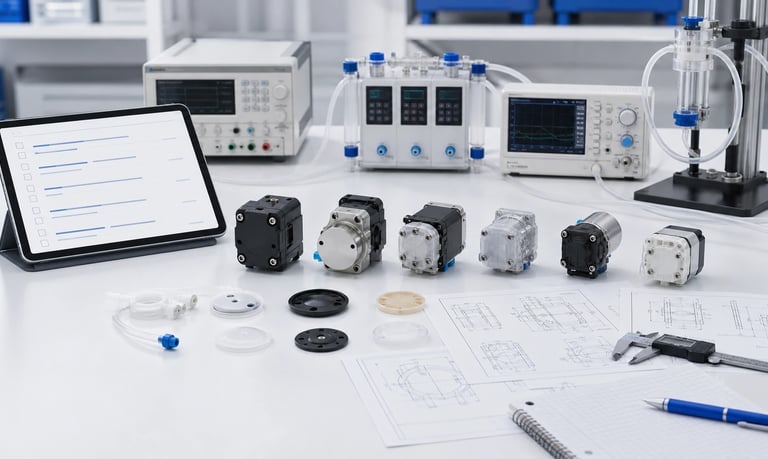
A productive micro pump supplier discussion should connect the OEM's fluid, flow, pressure, duty, environment, control, service, and regulatory needs to documented pump performance, material grades, test conditions, production tolerances, change control, sample plans, customization limits, supply terms, and technical support.
Questions to Ask a Micro Pump Manufacturer Before Selection
Choosing a micro pump manufacturer involves more than comparing nominal flow, pressure, voltage, and price. OEM teams need to understand how the data were measured, how performance varies between units, which materials actually contact the fluid, what limits continuous use, and how supplier changes will be controlled.
The quality of the answers depends on the quality of the application brief. A supplier cannot recommend a suitable configuration from a target flow alone. Fluid properties, inlet conditions, outlet pressure, duty cycle, control, environment, cleaning, noise, expected service, and production volume all affect selection.
Use the questions below to compare evidence, identify open risks, plan sample tests, and determine whether the supplier can support the project from prototype through production.
What Should the OEM Share First?
Provide a concise application specification before requesting a recommendation.
Include:
Liquid or gas identity
Concentration, viscosity, density, and temperature
Particles, fibers, bubbles, vapor, humidity, or condensation
Required flow or dose range
Inlet vacuum, suction lift, or source pressure
Outlet pressure, elevation, and downstream restrictions
Continuous, intermittent, prime, purge, and reverse modes
Supply voltage and control interface
Size, mounting, noise, heat, and power constraints
Cleaning, sterilizing, and maintenance process
Ambient, altitude, storage, and transport conditions
Expected production volume and schedule
Required documentation and applicable product requirements
Separate confirmed requirements from estimates. Mark unknown values so the manufacturer can recommend measurements or test conditions.
Avoid sending only a current pump model and asking for an equivalent. Explain why the current design is being changed and which performance must be preserved or improved.
Which Pump Type Fits the Application?
Ask the manufacturer to explain why the proposed mechanism suits the fluid and operating profile.
Useful questions include:
Why is a peristaltic, diaphragm, gear, piston, or other pump recommended?
Which application requirement drives that choice?
What are the main limitations of the proposed mechanism?
Which fluid-path components are likely to determine performance?
What alternative pump types were considered?
What conditions would make the recommendation unsuitable?
A strong answer should discuss tradeoffs, not only benefits. For example, a peristaltic pump isolates fluid in tubing but introduces tube wear and pulsation. A diaphragm pump can provide compact pressure or vacuum but depends on chamber filling and valve behavior.
Ask for the exact proposed configuration, including motor, gearbox, pump head, tubing, diaphragm, valves, driver, and firmware where applicable.
Under What Conditions Were Performance Data Measured?
Every flow, pressure, vacuum, noise, and power value requires context.
Ask:
What fluid or gas was used?
What temperature and ambient conditions applied?
What supply voltage, motor speed, or control command was used?
What inlet and outlet tubing and fittings were used?
Was flow measured at free flow or at a defined pressure?
Are pressure values gauge, absolute, differential, or vacuum?
Is gas flow actual, standardized, normal, or mass flow?
How long did the pump run before measurement?
Was the result typical, nominal, guaranteed, or a maximum limit?
What measurement method and equipment were used?
Request curves and test conditions rather than isolated headline values.
If the supplier cannot provide data for the exact fluid and system, agree on a representative sample test instead of assuming water or air results will transfer.
Can the Manufacturer Provide Complete Performance Curves?
Ask for performance across the operating range, not only a rated point.
Depending on pump type, request:
Flow versus speed or command
Flow versus outlet pressure
Flow versus inlet vacuum
Pressure and vacuum endpoints
Current and power versus load
Temperature rise versus duty
Noise and vibration versus speed
Prime time versus lift or restriction
Dose data at different command lengths
Pulsation or instantaneous flow where relevant
Ask whether curves represent typical units or production acceptance limits. Request the number and condition of samples used if that information is available.
For gas pumps, confirm both inlet and outlet absolute conditions. Ultimate vacuum, shutoff pressure, and free flow are different endpoints and should not be combined as one duty point.
For liquid pumps, ask how viscosity, temperature, tubing, and pressure change the curve.
How Much Unit-to-Unit Variation Should Be Expected?
A prototype selected from one sample may not represent production.
Ask:
What production tolerances apply to flow, pressure, vacuum, current, speed, and noise?
Are limits guaranteed or typical?
How are pump heads, tubing, diaphragms, valves, motors, and gearboxes controlled?
What run-in or stabilization occurs before final test?
What end-of-line tests are performed?
What data are retained by serial number or lot?
Can representative data from multiple lots be shared?
Understand which adjustments are made during manufacturing. A manually tuned occlusion, valve, screw, or calibration factor may create a different variation pattern from a fixed assembly.
Plan OEM tests using multiple production-representative samples. Do not create system margins from one unusually strong unit.
What Are the Exact Wetted Materials?
Request a complete wetted-material list, not only the main diaphragm or tube material.
Ask for exact grades or controlled specifications for:
Peristaltic tubing
Diaphragm and bonded layers
Inlet and outlet valves
Pump chamber and manifold
O-rings and gaskets
Ports and fittings
Adhesives, coatings, lubricants, and sealants that may contact fluid
Sensors, filters, and dampers supplied with the pump
Ask which materials contact product, cleaner, rinse, vapor, and mixed waste. Clarify what can become exposed after a diaphragm, tube, or seal failure.
Material-family names do not prove compatibility. Request the supplier's conditions and evidence, then validate the exact fluid, concentration, temperature, pressure, time, motion, cleaning, and idle exposure.
What Compatibility Evidence Is Available?
Ask how the proposed materials were evaluated.
Questions include:
Is compatibility based on supplier charts, static immersion, or dynamic pump tests?
Were exact finished components tested?
What concentration, temperature, and exposure time were used?
Were cleaning fluids and mixtures included?
Were swelling, hardness, dimensions, mass, permeation, or extraction measured?
Were valve response, diaphragm fatigue, tube recovery, flow, prime, and leakage measured?
What changes were considered acceptable?
Static data can support screening but do not establish dynamic life. A valve that shows little visible chemical change may still become too stiff, soft, swollen, or tacky to seal correctly.
If no direct evidence exists, ask the manufacturer to identify the most representative configuration and a safe test plan. Do not request a universal compatibility guarantee without defined conditions.
What Life and Reliability Data Are Available?
Pump life depends on the operating profile. Ask for the test conditions behind every life statement.
Request:
Pump configuration and sample quantity
Fluid or gas
Speed and pressure
Inlet condition
Voltage and driver
Ambient and pump temperature
Continuous or intermittent duty
Starts, stops, reversals, and stalls
Cleaning cycles
Acceptance criteria and failure mode
Performance drift during the test
Ask whether the result covers the motor, bearings, gearbox, tubing, diaphragm, valves, seals, and electronics or only one component.
A peristaltic tube may have a shorter replacement interval than the motor. A brushless motor removes brush wear but not bearing, gearbox, pump-head, or driver failure mechanisms.
Use supplier data to design representative OEM life tests. Do not copy one lifetime number into a product claim without matching conditions and sufficient validation.
What Duty Cycle Is Approved?
Clarify the meaning of continuous, intermittent, and maximum ratings.
Ask:
Is the proposed operating point approved for continuous use?
What ambient and enclosure temperature apply?
What pressure and speed limits apply at that duty?
Is a cooling period required?
What temperature was reached in supplier testing?
Are prime, purge, and blockage conditions included?
What software or hardware protection is required?
Average duty cycle can hide demanding short events. Frequent starts, high startup torque, valve switching, or repeated pressure spikes may create more stress than a steady run.
Provide the full sequence and ask the supplier to review it. Test the pump in the final closed enclosure until temperature stabilizes.
How Does the Pump Behave at Operating Extremes?
Ask for known limits and failure modes at:
Minimum and maximum supply voltage
Cold startup and maximum ambient temperature
Minimum and maximum fluid viscosity
Full and low reservoir level
Maximum suction lift or inlet restriction
Maximum outlet pressure
Clean and loaded filters
Minimum and maximum speed
Long idle and restart
Product orientation and altitude
Ask which condition is expected to become the first practical limit: motor torque, tube refill, valve response, pressure, current, temperature, noise, or component life.
The answer can guide system margin and sensor placement. It also reveals whether the supplier has tested the real boundary rather than only nominal operation.
What Motor and Control Options Are Available?
Ask which motor configuration best matches the duty and control requirement.
Topics include:
Brushed DC, brushless DC, or stepper motor
Direct drive or gearbox
Open-loop or closed-loop speed
Position or rotation feedback
PWM, analog, frequency, step/direction, or digital interface
Direction reversal and braking
Acceleration and deceleration
Startup and minimum stable speed
Current limit and stall response
Integrated or external driver
Request interface definitions, timing, input limits, connector information, and example control sequences.
For smart pumps, ask about protocol, commands, telemetry, error codes, firmware version, update process, watchdog, communication loss, and power-up state.
Confirm that the pump cannot start unexpectedly during boot, reset, communication recovery, or firmware update.
What Fault Detection and Protection Exist?
Ask what the pump can detect and what the OEM must implement.
Consider:
Locked rotor or stall
Overcurrent
Overtemperature
Under- or overvoltage
Missing motor feedback
Communication loss
Empty source
Inlet leak
Blocked inlet or outlet
Tube rupture
Diaphragm or valve failure
Flow or pressure deviation
Motor current alone may not distinguish high viscosity, blockage, cold fluid, excessive tube compression, wear, or low voltage.
Ask how faults are reported, latched, reset, and logged. Clarify whether the integrated driver retries automatically and what happens when the obstruction clears.
Define the safe state with the supplier. A stopped pump may not prevent siphoning, backflow, leakage, or stored-volume release.
What Noise and Vibration Data Are Available?
Noise depends on speed, pressure, mounting, tubing, driver, enclosure, and measurement method.
Ask:
At what distance and orientation was sound measured?
Was the pump mounted or suspended?
What fluid, pressure, speed, and voltage applied?
Was the enclosure open or closed?
Are frequency spectra available?
How does noise change with pump age and temperature?
Are vibration measurements available at mounting points?
Which speeds create tonal or resonant behavior?
Request production variation if acoustic performance is important.
Use supplier data for screening, then test the final product. Tubing, brackets, cables, panels, reservoirs, and valves can transmit or amplify pump vibration.
Ask whether changing PWM, microstep, speed, or mount conditions affects approved torque, heat, electromagnetic compatibility, and life.
What Sample Configuration Should Be Tested?
Ask the manufacturer to recommend samples that represent the intended production design.
Clarify:
Exact part numbers and revisions
Motor and driver options
Tube, diaphragm, valve, and fitting materials
Connector and cable
Firmware and default settings
Whether samples are hand-built or production-line units
Whether samples have been run in or calibrated
What production variation should be included
Which spare consumables or replacement parts are needed
Avoid testing a special laboratory configuration that cannot be purchased in production.
Request more than one sample when variation matters. Mark each sample uniquely and preserve its test history.
Agree on the supplier data and OEM test results that should be exchanged before the next selection decision.
What Should the OEM Test on Samples?
Ask the supplier to review the OEM test matrix and identify conditions that could damage the sample or produce misleading results.
The plan may include:
Flow or dose across the operating range
Inlet vacuum and outlet pressure
Dry prime, wet restart, and low reservoir
Fluid temperature and viscosity extremes
Minimum and maximum voltage
Current, speed, and thermal stabilization
Noise and vibration
Leakage, backflow, siphoning, and shutoff
Faults and power loss
Cleaning, idle, and restart
Early wear and performance drift
Request supplier limits for test pressure, vacuum, voltage, speed, temperature, and dry run.
Share unexpected results with full configuration and raw data rather than a conclusion such as "the pump failed." This allows the manufacturer to compare the condition with its own tests.
What Customization Is Available?
Customization may include motor, gear ratio, tube, pump head, diaphragm, valve, ports, fittings, connector, cable, mount, driver, firmware, and control interface.
Ask:
Which features are standard options?
Which require new tooling or development?
What is the minimum order or project volume?
Who owns drawings, tooling, firmware, and validation data?
What development and sample stages apply?
How are custom part numbers controlled?
What tests will be repeated after customization?
Can a standard fallback remain available?
A small change can have broad effects. A different tube or valve changes flow, pressure, compatibility, and life. A different motor or driver changes heat, noise, control, and electromagnetic behavior.
Request a documented change-impact review instead of assuming a customized pump retains all standard-model data.
How Are Quality and Traceability Managed?
Ask how the manufacturer controls critical components and process steps.
Topics include:
Incoming material controls
Approved suppliers
Critical dimensions and properties
Assembly instructions and fixtures
Torque, occlusion, bonding, curing, and cleanliness controls
In-process and end-of-line testing
Calibration and test-equipment control
Lot and serial traceability
Nonconformance handling
Failure analysis and corrective action
Record-retention period
Ask which test data can be linked to the pumps shipped to the OEM.
If the OEM has special cleanliness, contamination, packaging, or fluid-test requirements, discuss them before production planning.
A quality certificate or general management-system statement does not replace component-specific controls and acceptance data.
How Are Supplier Changes Controlled?
Pump performance can change after a material, supplier, motor, magnet, gear, lubricant, tube, diaphragm, valve, electronic component, firmware, tooling, or process change.
Ask:
Which changes require customer notification?
How much notice is provided?
What evidence accompanies the change?
Can the OEM approve or reject critical changes?
How are emergency substitutions handled?
Are last-time-buy or transition arrangements available?
How are firmware and configuration revisions identified?
What requalification does the manufacturer perform?
Define change terms in the supply and quality agreement where appropriate.
Do not rely only on identical external part numbers. Ask how internal revisions are tracked and whether mixed revisions can be shipped together.
Plan an OEM impact assessment and focused or full revalidation based on the changed characteristic.
What Documentation Can Be Provided?
Document needs depend on the product and market. Ask early because some information may require confidentiality agreements or additional testing.
Possible documents include:
Datasheet and controlled drawing
Performance curves and test methods
Wetted-material declaration
Compatibility or life-test reports
Electrical interface and protocol
Connector and pinout drawing
CAD model
Reliability or failure analysis summary
Production test specification
Material or restricted-substance declarations
Change-control statement
Quality-system and traceability information
Do not assume that a general material statement supports food, medical, regulatory, safety, or market-specific claims for the final OEM product.
Confirm whether documentation covers the exact part number, grade, supplier, manufacturing site, and revision.
The OEM remains responsible for determining and validating the applicable finished-product requirements.
What Are the Commercial and Supply Conditions?
Technical suitability must align with a sustainable supply plan.
Ask:
Sample price and availability
Production pricing assumptions
Minimum order quantity
Standard and forecast lead time
Capacity and ramp plan
Packaging quantity and method
Shelf-life or storage requirements for consumables
Production location
Second-source strategy for critical parts
Forecast and order-flexibility expectations
End-of-life notification
Warranty and return process
Clarify whether quoted pricing applies to the tested configuration, including driver, cable, connector, fittings, and tube.
Long-life consumables may still require controlled storage. Ask how tubing, diaphragms, valves, adhesives, and lubricants should be stored and how lot age is identified.
Evaluate total cost, including electronics, fixtures, calibration, maintenance, consumables, validation, and supply risk.
What Technical Support Is Available?
Ask who will support application questions, sample testing, customization, failures, and production changes.
Useful questions include:
Is an application engineer available?
What information is needed to review a system?
Can the supplier review fluid-path drawings and test data?
What response time is typical for technical issues?
Can failed samples be analyzed?
What data should accompany a return?
Is onsite or remote integration support available?
How are questions tracked and decisions documented?
Good support does not mean the supplier makes the OEM's validation decisions. It means both teams can exchange clear technical evidence and resolve configuration questions efficiently.
Identify language, time-zone, and confidentiality needs early.
How Should Supplier Answers Be Evaluated?
Separate answers into four categories:
Documented measured data
Controlled specification or guarantee
Engineering estimate
Unknown or not yet tested
All four can be useful when labeled correctly. Problems arise when a typical result is treated as a guarantee or an assumption is copied into a product requirement.
Look for answers that include conditions, units, methods, sample identity, and limits. Ask follow-up questions when terms such as continuous, compatible, quiet, accurate, or long life are not defined.
Create an open-issue list with owner, evidence needed, and decision date. A supplier comparison matrix should retain the source behind every score.
Do not select solely on the largest headline specification. A pump with well-defined limits and responsive technical support may present less integration risk than a pump with a stronger nominal value and unclear evidence.
Manufacturer-Selection Checklist
OEM application brief includes fluid, flow, pressure, duty, environment, and control
Supplier explains pump-type recommendation and limitations
Exact pump, motor, head, consumables, driver, and firmware identified
Performance data include test conditions, units, and pressure references
Full curves cover required flow, pressure, vacuum, voltage, and speed
Typical, guaranteed, nominal, and maximum values distinguished
Production tolerances and end-of-line tests understood
Complete exact-grade wetted-material list obtained
Compatibility evidence reviewed for product, cleaner, temperature, and motion
Life data include load, duty, temperature, samples, drift, and failure mode
Operating extremes and approved duty region defined
Motor, control interface, feedback, and startup behavior documented
Fault detection, shutdown, retry, and safe state reviewed
Noise and vibration test method understood
Sample configuration represents intended production design
OEM sample-test matrix reviewed with supplier limits
Customization scope, ownership, schedule, and revalidation defined
Quality, traceability, change notification, and second sources reviewed
Required drawings, declarations, and reports tied to exact part number
MOQ, lead time, capacity, storage, warranty, and end-of-life terms reviewed
Technical contacts and failure-analysis process identified
Evidence, assumptions, unknowns, and open actions tracked separately
Common Supplier-Selection Mistakes
Sending only target flow without fluid or pressure conditions
Selecting from free-flow data
Comparing maximum vacuum, pressure, and flow as simultaneous
Treating typical performance as a production guarantee
Asking only for the main wetted material
Accepting a generic chemical-compatibility statement
Using a lifetime number without its test conditions
Assuming brushless means silent or unlimited life
Testing one special sample instead of production-representative units
Customizing a component without repeating affected tests
Ignoring firmware, driver, and startup-state behavior
Relying on certification language not tied to the exact part
Omitting supplier-change notification from planning
Comparing unit price without integration and service cost
Treating unclear answers as confirmed requirements
Frequently Asked Questions
What information should I send a micro pump manufacturer first?
Send fluid or gas properties, flow or dose, inlet and outlet conditions, duty cycle, voltage, control, temperature, enclosure, cleaning, noise, service, documentation, volume, and schedule.
Should I ask for a maximum flow or a performance curve?
Ask for curves with test conditions. Maximum flow is often a free-flow endpoint and does not show performance at the application's pressure, vacuum, fluid, voltage, or temperature.
How can I verify a supplier's lifetime claim?
Request the pump configuration, sample quantity, load, speed, pressure, fluid, temperature, duty, starts, cleaning, acceptance criteria, drift, and failure mode, then run representative OEM tests.
Is a wetted-material list enough to prove chemical compatibility?
No. Exact material grades and all fluids, concentrations, temperatures, pressures, exposure times, cleaning cycles, and dynamic component behavior must be reviewed and tested.
How many samples should be requested?
There is no universal number. Request enough production-representative samples to assess function and relevant variation, then use a risk-based plan for life, destructive, and validation testing.
What is the most important supplier quality question?
Ask how critical materials, dimensions, assembly processes, end-of-line performance, traceability, and changes are controlled for the exact pump configuration.
Kamoer Micro Pump Selection Support
Kamoer can help OEM teams review fluid, flow, pressure, motor, control, tubing, diaphragm, valve, duty, materials, sample configuration, test conditions, customization, and integration requirements before pump selection.
Related Stories
Kamoer Fluid Tech (Shanghai) Co., Ltd.
pump@kamoer.com