

Peristaltic Pump vs Diaphragm Pump: Which Should You Choose
MICRO PUMP BASICS
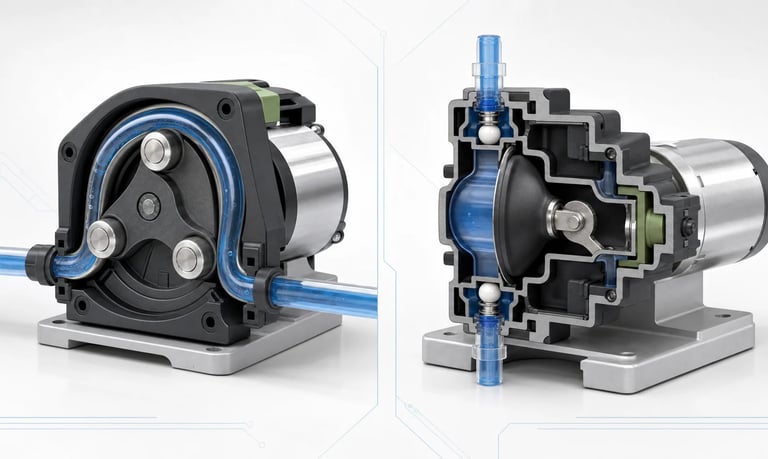
This engineering comparison explains when to choose a peristaltic pump or diaphragm pump by evaluating the fluid path, flow and pressure, pulsation, material compatibility, maintenance, control, and OEM integration requirements.
Peristaltic Pump vs Diaphragm Pump: Which Should You Choose?
Peristaltic pumps and diaphragm pumps are both positive-displacement technologies used in compact fluid systems. Either can move liquid in OEM equipment, but they create flow in different ways and expose the fluid to different components.
A peristaltic pump moves fluid by compressing flexible tubing with rotating rollers. The liquid remains inside the tube. A diaphragm pump changes the volume of an internal chamber while inlet and outlet valves direct the fluid. The liquid therefore contacts several internal wetted parts.
This difference influences chemical compatibility, maintenance, pressure, pulsation, priming, installation, and long-term performance. The better choice is not universal. It depends on the medium, required operating point, control strategy, service plan, and equipment design.
Quick Comparison
Pumping Method
Peristaltic pump: Rollers compress flexible tubing to move fluid forward.
Diaphragm pump: A diaphragm changes chamber volume while check valves direct the flow.
Fluid Contact
Peristaltic pump: The medium contacts the tubing and external fluid-path components.
Diaphragm pump: The medium contacts the diaphragm, valves, chamber, seals, ports, and external fluid-path components.
Main Wear Parts
Peristaltic pump: The pump tubing is the main planned consumable, alongside normal drive-component wear.
Diaphragm pump: The diaphragm, valves, seals, motor, and drive components may wear over time.
Fluid-Path Replacement
Peristaltic pump: Replacing the wetted path is often straightforward when the tubing is accessible.
Diaphragm pump: Renewing the internal wetted path usually requires pump servicing, a repair kit, or module replacement.
Pulsation
Peristaltic pump: Pulsation comes from successive roller compression and tube-recovery events.
Diaphragm pump: Pulsation comes from reciprocating suction and discharge strokes.
Particles and Crystals
Peristaltic pump: Suitability depends mainly on tube bore, particle size, concentration, and abrasiveness.
Diaphragm pump: Internal valves can be sensitive to particles, fibers, deposits, and crystals that interfere with sealing.
Flow Direction
Peristaltic pump: Flow can usually be reversed by reversing motor direction.
Diaphragm pump: Flow is normally directional because of its inlet and outlet check valves.
Dry-Running Tolerance
Peristaltic pump: Dry operation is often possible within model-specific limits, although tube wear continues.
Diaphragm pump: Dry-running capability is model-dependent and must be confirmed.
Pressure Capability
Peristaltic pump: Pressure depends on the model, tubing, occlusion, speed, motor torque, and operating conditions.
Diaphragm pump: Pressure depends on the model, chamber, valves, motor, and actual operating point.
Typical Best Fit
Peristaltic pump: Often selected for an isolated, replaceable fluid path and controlled dosing.
Diaphragm pump: Often selected for compact transfer through an integrated chamber and valve system.
This comparison is a starting point, not a final selection rule. Both pump types vary substantially by size, motor, materials, and design.
Difference in Working Principle
How a Peristaltic Pump Moves Fluid
Rollers press a flexible tube against a curved track. As the rotor turns, each compression point moves along the tube and pushes trapped fluid toward the outlet. The tube recovers behind the roller and draws more fluid into the inlet.
The tube is simultaneously the pumping element and the main wetted component. Its dimensions, material, elasticity, and condition directly affect flow and suction.
How a Diaphragm Pump Moves Fluid
A motor and eccentric drive flex a diaphragm. Pulling the diaphragm away from the chamber creates suction and opens the inlet valve. Pushing it toward the chamber raises pressure, closes the inlet valve, and opens the outlet valve.
Reliable valve response and sealing are essential. Restrictions, particles, deposits, viscosity, or incompatible materials can change chamber filling and discharge.
Fluid Contact and Contamination Control
Fluid-path design is often the first deciding factor.
Peristaltic Pump Fluid Path
In a standard peristaltic pump, the medium contacts only the tubing and any external fittings or sensors. Replacing the tube can renew the primary wetted and pumping component.
This design can be useful for reagents, samples, additives, and fluids that should remain isolated from a reusable chamber. It does not automatically guarantee sterility, zero contamination, or compliance. Those outcomes depend on tubing, connectors, assembly, handling, and the complete equipment design.
Diaphragm Pump Fluid Path
A diaphragm liquid pump exposes the medium to the diaphragm, valves, chamber, seals, and ports. Each material and interface must be reviewed.
The enclosed fluid path can be compact and convenient in an OEM product, but it is less practical when users need to replace the entire wetted path frequently.
Selection Guidance
Choose a peristaltic design when a replaceable isolated tube is a primary requirement. Consider a diaphragm pump when an integrated internal fluid path is acceptable and compact transfer is more important than routine fluid-path replacement.
Flow Rate and Dosing Performance
Neither technology is inherently accurate under every condition. Accuracy and repeatability are system properties.
Peristaltic Pump Flow
Delivered volume depends on tube inner diameter, wall thickness, compression, motor speed, viscosity, inlet conditions, back pressure, temperature, and tube wear. Speed and run time can provide useful dosing control, especially when the system is calibrated.
Tube properties change with repeated compression. Precision applications may require periodic verification and recalibration after tube replacement.
Diaphragm Pump Flow
Flow depends on chamber displacement, stroke rate, valve behavior, fluid viscosity, suction conditions, outlet pressure, supply voltage, and motor speed. Increasing downstream pressure normally reduces delivered flow.
Simple diaphragm pumps are often selected for transfer rather than precision metering. Controlled or feedback-equipped designs can improve repeatability, but validation is still required.
Selection Guidance
For small timed doses and easy calibration through speed or run time, a peristaltic pump is often a practical candidate. For compact transfer where a stable average flow is sufficient, a diaphragm liquid pump may be appropriate. Test the actual dose or flow at the intended operating point.
Pressure, Suction, and Priming
Maximum free-flow data is not enough for pump selection.
Peristaltic Pump Considerations
Tube recovery creates suction and allows many peristaltic pumps to self-prime. Pressure capability depends on tubing, pump-head track, occlusion, motor torque, speed, and discharge resistance.
Excessive pressure can reduce flow, increase tube stress, shift the tube, create leakage, or overload the motor.
Diaphragm Pump Considerations
Chamber displacement and valve sealing allow many diaphragm pumps to self-prime and work against downstream pressure. Actual flow must be read at the required pressure rather than at free flow.
Inlet leaks, blocked filters, contaminated valves, or viscous liquids can reduce suction and delay priming.
Selection Guidance
Do not assume that every diaphragm pump provides higher pressure or that every peristaltic pump has weak suction. Compare verified performance curves and test the complete inlet and outlet path.
Pulsation and Flow Smoothness
Both technologies produce pulsating flow.
Peristaltic pump pulsation results from rollers entering and leaving the compression zone. Roller count, tube elasticity, speed, pump-head geometry, and outlet compliance affect the pulse profile.
Diaphragm pump pulsation comes from separate suction and discharge strokes. Chamber volume, stroke frequency, valve timing, tubing, and downstream volume influence the result.
Where smooth flow is important, possible measures include lower speed, flexible tubing, a pulsation damper, an accumulator, multiple channels or chambers, and feedback control. The most effective method depends on the application.
Chemical Compatibility
Chemical compatibility is simpler to review in a peristaltic pump, but it is not automatic.
Peristaltic Pump Materials
The tube is the main wetted component. Changing tubing material may allow the pump concept to handle a different fluid, provided the tube also has suitable elasticity, dimensions, fatigue resistance, and pump-head compatibility.
Diaphragm Pump Materials
The diaphragm, valve elements, chamber, seals, and ports all require review. One compatible component does not make the complete pump compatible.
Selection Guidance
For either technology, verify compatibility using the exact chemical, concentration, temperature, pressure, and exposure time. Include cleaning and storage conditions. A short immersion test alone may not predict mechanical life under repeated pumping.
Particles, Crystals, and Suspended Solids
A peristaltic pump has no internal check valves in the primary pump head. It may tolerate some suspended particles when tube bore, particle size, concentration, abrasiveness, and fluid behavior are suitable. Particles can still cause blockage, abrasion, or dosing variation.
A diaphragm pump relies on valves that must seal repeatedly. Particles, fibers, crystals, or dried residue may hold a valve open and reduce suction or pressure.
For media containing solids, describe the maximum particle size, concentration, settling behavior, and tendency to crystallize. Application testing is essential.
Maintenance and Service Planning
Peristaltic Pump Maintenance
Tubing is a planned consumable. Maintenance generally includes inspection, tube replacement, pump-head cleaning, roller checks, and flow recalibration. A well-designed pump head can make tube replacement quick, but the equipment must provide access.
Diaphragm Pump Maintenance
Wear may involve the diaphragm, valves, seals, motor, and drive. Depending on pump construction, servicing may require a repair kit, trained disassembly, or pump replacement. Filters and fluid cleanliness can have a major effect on valve life.
Selection Guidance
Choose based on the acceptable service model. A replaceable tube can be advantageous when operators can access the pump. A sealed diaphragm module may be preferable when the device uses clean compatible fluid and module replacement is acceptable.
Noise, Vibration, and Installation
Peristaltic pumps can generate roller engagement noise, motor noise, and tube-related vibration. Diaphragm pumps create reciprocating mechanical forces and pressure pulses.
Sound measured on an open bench may differ greatly after mounting inside an enclosure. Rigid panels, tubing contact, and structural resonances can amplify noise.
Evaluate mounting orientation, isolation, tubing routing, ventilation, cable position, connector access, and maintenance clearance in the final product structure.
Control and OEM Integration
Both pump types may be available with brushed DC, brushless DC, stepper, or other drives. Available controls can include fixed speed, PWM, analog input, direction control, feedback, or digital communication.
Peristaltic pumps are normally reversible when the motor direction is reversed. A standard diaphragm pump remains directional because its valves determine the flow path, even if the motor direction changes.
Define voltage, current, start-up behavior, speed range, electromagnetic requirements, fault handling, and expected duty cycle before choosing a model.
Application-Based Selection Examples
Reagent Dosing in an Analyzer
A peristaltic pump may be preferred when reagent isolation, tube replacement, and controlled small doses are important. A diaphragm pump can be suitable for transfer or washing when wetted materials are compatible and the dose requirement matches its performance.
Water Sampling
A peristaltic pump can isolate the sample in replaceable tubing and may handle intermittent sampling well. A diaphragm pump may offer compact transfer when sample characteristics, valves, and maintenance conditions are suitable.
Beverage Dispensing
A peristaltic pump can dose concentrates through replaceable tubing. A diaphragm pump may transfer water or compatible liquids within an enclosed module. Materials, cleaning, and compliance must be confirmed for the final application.
Cleaning Equipment
A diaphragm liquid pump is often a practical candidate for water or detergent transfer in compact equipment. A peristaltic pump may be useful for controlled chemical dosing or when fluid-path replacement is needed.
Gas Sampling or Vacuum
Use a diaphragm gas pump designed for gas flow, pressure, or vacuum. A liquid peristaltic pump comparison is not sufficient for this function unless a specific peristaltic design has verified gas performance.
Selection Checklist
Before making a final choice, document:
Liquid or gas medium
Chemical composition, concentration, temperature, and viscosity
Particles, fibers, bubbles, or crystallization risk
Required flow or dose at the actual pressure or vacuum
Suction height and inlet restrictions
Continuous or intermittent duty cycle
Accuracy, repeatability, and calibration method
Wetted-material requirements
Expected maintenance and replacement process
Power supply and control interface
Noise, vibration, size, mounting, and tubing layout
Applicable documentation or compliance requirements
Validation plan using the real fluid path
Frequently Asked Questions
Is a peristaltic pump more accurate than a diaphragm pump?
Not automatically. Accuracy depends on pump design, control, calibration, pressure, viscosity, temperature, and wear. A peristaltic pump often provides convenient timed dosing, but its tubing changes over time.
Which pump is better for corrosive liquids?
The better option is the one with verified compatible wetted materials. A peristaltic pump reduces the review mainly to tubing and external fittings, while a diaphragm pump requires evaluation of multiple internal components.
Which pump handles particles better?
Peristaltic pumps have no internal valves in the pump head and may be less sensitive to some suspended particles. Suitability still depends on particle size, concentration, abrasiveness, tube bore, and operating conditions.
Which pump is easier to maintain?
A peristaltic pump is often easier when routine tube replacement is acceptable and accessible. A diaphragm pump may require less frequent routine fluid-path handling with clean compatible media, but valve or diaphragm service can be more involved.
Can both pumps run dry?
Many peristaltic pumps and some diaphragm pumps can tolerate dry operation within model-specific limits. Dry-running capability and acceptable duration must be confirmed rather than assumed.
Which pump is better for OEM equipment?
Both can be effective. Select the peristaltic pump for an isolated, replaceable tube path or controlled dosing. Select the diaphragm pump for compact chamber-based transfer when internal wetted materials and valves suit the medium.
Kamoer Pump Selection Support
Choosing between a peristaltic pump and a diaphragm pump requires a system-level comparison. Fluid-path isolation may favor a peristaltic design, while compact integrated transfer may favor a diaphragm pump. Flow, pressure, compatibility, maintenance, control, and installation must be evaluated together.
Kamoer develops micro peristaltic pumps, diaphragm liquid pumps, diaphragm gas pumps, laboratory pumps, and customized OEM fluid-transfer solutions. Kamoer can help compare pump technologies using the actual medium, operating point, duty cycle, control method, and mechanical constraints.
Share your application requirements with Kamoer to begin a pump-selection review and plan representative testing before final integration.
Related Stories
Kamoer Fluid Tech (Shanghai) Co., Ltd.
pump@kamoer.com