

Micro Pumps for Water Quality Sampling Systems
APPLICATIONSWATER ANALYSIS WATER TREATMENT
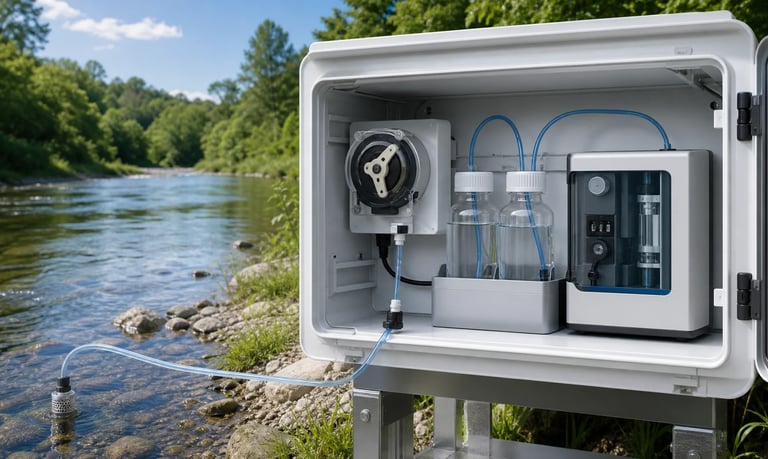
Reliable water quality sampling depends on matching the micro pump to sample integrity, suction height, tubing, particles, target flow, cleaning method, duty cycle, temperature, and maintenance conditions in the field.
Micro Pumps for Water Quality Sampling Systems
Water quality instruments use micro pumps to collect samples, transfer water to sensors, dose reagents, rinse fluid paths, and remove waste. Pump selection affects sample integrity, response time, maintenance, and measurement reliability.
The correct pump cannot be selected from flow alone. Suction height, tube length, particles, biofilm, temperature, cleaning chemicals, duty cycle, and the way the sample contacts wetted materials must all be considered.
Define the Sampling Function
A system may need to:
Pull a discrete sample from a river, tank, or process line
Provide continuous flow through a sensor chamber
Fill sample bottles
Dose reagent into an analysis cell
Drain or flush the fluid path
Reverse flow for purging or recovery
Define minimum, typical, and maximum flow, sample volume, collection time, and frequency. Continuous sensor flow and occasional bottle sampling usually require different operating ranges.
Protect Sample Integrity
The pump and fluid path should not introduce unacceptable contamination, adsorption, carryover, or chemical change.
A peristaltic pump keeps the sample inside replaceable tubing, which can simplify wetted-material control and cleaning. A diaphragm liquid pump uses an internal chamber and valves, so all internal wetted materials must be reviewed.
Suitability depends on the analytes and method. A material acceptable for general water transfer may adsorb an organic compound or release substances that influence a sensitive measurement.
Evaluate Suction Height and Inlet Layout
Field samplers often place the pump above the water source. Measure vertical suction height from the lowest expected water level to the pump inlet.
Long narrow tubing, filters, fittings, and air leaks increase priming time and reduce flow. Validate:
Dry-line priming time
Stable flow after priming
Restart after drain-back
Minimum water level
Maximum tube length
Expected temperature and altitude
Keep the inlet path short and well sealed where practical.
Handle Particles and Sediment
Natural water may contain sand, silt, algae, fibers, and suspended solids. These can block tubing and filters or prevent diaphragm-pump valves from sealing.
Describe particle size, concentration, abrasiveness, and settling behavior. Select an inlet screen or filter that protects the system without creating excessive resistance as it loads.
Filter condition should be included in pressure and flow testing.
Choose Between Pump Types
Peristaltic Pumps
Consider a peristaltic pump when an isolated replaceable tube path, reversible flow, self-priming, or easy fluid-path maintenance is important. Tubing wear and flow drift require a replacement and calibration plan.
Diaphragm Liquid Pumps
Consider a diaphragm pump for compact integrated transfer when sample characteristics are compatible with the chamber and valves. Particles, crystals, deposits, and bubbles can affect valve operation.
Diaphragm Gas Pumps
Gas pumps may support air purging or gas-analysis functions, but they should not be used for unrestricted liquid transfer unless specifically designed for it.
Select Tubing and Wetted Materials
Review the sample, preservatives, reagents, rinsing liquids, disinfectants, and cleaning chemicals. Compatibility should be verified at the actual concentration, temperature, pressure, and exposure time.
For peristaltic pumps, tube dimensions and fatigue resistance must also match the pump head. For diaphragm pumps, review the diaphragm, valves, chamber, seals, and ports.
Control Flow and Sampling Volume
Flow affects transport delay, sensor response, particle behavior, bottle filling, and power use. High speed may shorten collection time but increase pressure loss, tube wear, bubbles, or sample disturbance.
Calibrate using the actual inlet height, tubing, filter, sample fluid, and outlet arrangement. Timed operation alone may not maintain a fixed volume as filters load or tubing ages.
Critical systems may use flow, pressure, level, or weight feedback.
Plan Cleaning and Carryover Control
Residual sample can affect the next measurement. A cleaning sequence may include draining, rinsing, reversing, air purging, or using a dedicated tube path.
Validate cleaning with the real analytes and contamination limits. Avoid dead zones, low points, and fittings that trap sediment. Confirm that cleaning chemicals do not damage tubing, valves, seals, or sensors.
Design for Field Conditions
Outdoor systems may face heat, freezing, humidity, altitude, vibration, insects, dust, and unstable power. Enclosures can trap motor heat, while cold conditions can increase viscosity and reduce tube flexibility.
Test the pump inside the final enclosure. Include condensation, transport vibration, storage, and power interruption where relevant.
Maintenance Planning
Inspect and replace peristaltic tubing before leakage.
Check filters and inlet screens for loading.
Inspect fittings for air leaks.
Flush deposits and biological growth.
Verify flow after service.
Record run hours, samples, pressure, and replacement history.
Provide safe access without disturbing calibrated sensors.
Validation Checklist
Actual water source or representative samples
Minimum and maximum suction height
Clean and loaded filters
Particle and sediment conditions
Temperature and altitude range
Priming, drain-back, and restart
Sample volume and carryover
Cleaning and preservation chemicals
Long-term tubing or valve wear
Empty-source and blocked-line faults
Frequently Asked Questions
Why are peristaltic pumps common in water sampling?
The sample remains inside replaceable tubing, and the pump can often self-prime and reverse flow. Final suitability depends on tubing, height, particles, pressure, and maintenance.
Can a sampling pump handle sediment?
Possibly, but particle size, concentration, abrasiveness, tube bore, valves, and filters must be evaluated.
How does suction height affect flow?
Greater height increases inlet vacuum and priming time. Actual flow may decrease, especially with long tubing, restrictions, or viscous samples.
How often should sampling tubing be replaced?
Set the interval from representative life tests, inspection, flow drift, contamination risk, and field maintenance requirements.
Can one pump collect samples and dose reagent?
It may be possible, but flow range, cross-contamination, material compatibility, and calibration can favor separate channels or pumps.
Kamoer Water Sampling Support
Kamoer can help evaluate sampling flow, suction height, tubing, particles, cleaning, control, duty cycle, and OEM integration for environmental monitoring and water analysis equipment.
Related Stories
Kamoer Fluid Tech (Shanghai) Co., Ltd.
pump@kamoer.com