

Micro Pumps for IVD and Laboratory Instruments
APPLICATIONSIVD DIAGNOSTIC EQUIPMENT
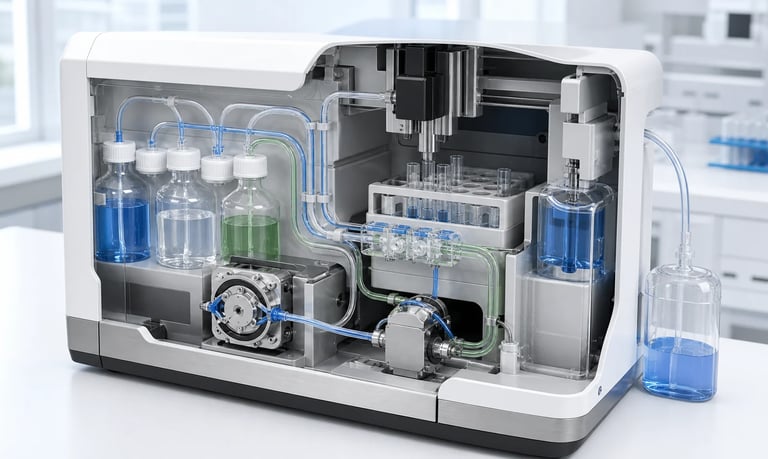
Reliable fluid handling in IVD and laboratory instruments depends on matching micro pumps to reagent dosing, sample aspiration, fluid-path materials, bubbles, pressure, cleaning, calibration, duty cycle, and service requirements.
Micro Pumps for IVD and Laboratory Instruments
IVD and laboratory instruments use micro pumps to aspirate samples, dispense reagents, circulate liquids, wash reaction areas, remove waste, and generate vacuum or pressure. Pump performance can influence dose repeatability, carryover, bubble formation, response time, noise, and maintenance.
Selection should begin with the instrument's fluid-handling function and risk controls. Use in an IVD or laboratory device does not by itself mean that a pump has a particular medical approval or regulatory status.
Define the Fluid-Handling Function
List every task assigned to the pump:
Sample aspiration and transfer
Reagent or calibrator dosing
Wash-fluid delivery
Waste removal
Probe rinsing
Liquid circulation
Gas sampling, vacuum, or pressure
Define volume, active flow, timing, frequency, acceptable variation, and whether flow must reverse. One pump may cover several compatible functions, but separate channels can reduce carryover and simplify calibration.
Choose the Pump Technology
Peristaltic Pumps
Peristaltic pumps keep fluid inside replaceable tubing. They are often considered for reagent transfer, washing, waste, and applications where an isolated fluid path or easy tube replacement is useful.
Flow depends on tubing, speed, viscosity, pressure, temperature, and wear. Tubing is a planned consumable and requires calibration and preventive replacement.
Diaphragm Liquid Pumps
Diaphragm pumps provide compact chamber-based liquid transfer. They may suit washing, drainage, circulation, or reagent movement when all internal wetted materials are compatible.
Particles, crystals, sticky residue, and bubbles can affect valves and priming.
Diaphragm Gas Pumps
Gas pumps can provide aspiration, air movement, vacuum, or pressure for sensor paths and pneumatic functions. Select performance at the required vacuum or pressure rather than from free-flow data alone.
Control Dose and Flow
For dosing, define the smallest and largest volume, delivery time, accuracy, and repeatability. Timed on-off control may suit noncritical transfer, while stepper control, speed commands, or sensor feedback may support more demanding functions.
Calibration must use the final reagent, tubing, valves, nozzle, pressure, and temperature. Water data may not represent a viscous reagent or cleaning solution.
Manage Bubbles and Priming
Bubbles can change aspirated volume, interrupt sensors, alter pressure, and affect valve behavior. They may enter through leaks, empty reservoirs, outgassing, foaming, or poor tubing layout.
Useful controls include:
Short, sealed inlet paths
Bubble or liquid detection
Controlled priming routines
Degassing where appropriate
Reservoir designs that avoid vortexing
Software timeouts for failed aspiration
Test the transition between air and liquid, not only steady liquid flow.
Review Wetted Materials
Identify every component contacting samples, reagents, calibrators, wash fluids, disinfectants, and waste.
For peristaltic pumps, review the pump tube and external fittings. For diaphragm liquid pumps, include the diaphragm, valves, chamber, seals, and ports.
Compatibility should be verified under actual concentration, temperature, pressure, and exposure time. Also consider adsorption, permeation, extractables, and carryover where relevant to the assay.
Minimize Carryover and Dead Volume
Residual liquid can affect the next sample or reagent. Fluid-path volume, low points, connectors, valves, probe geometry, and cleaning sequence all contribute.
A replaceable peristaltic tube can simplify part of the wetted path, but reservoirs, fittings, sensors, and outlets still require cleaning and validation.
Design the shortest practical path, avoid unnecessary cavities, and confirm wash effectiveness with representative materials.
Account for Pressure and Restrictions
Probe tips, filters, valves, flow cells, narrow tubing, and elevation create resistance. Higher back pressure can reduce flow and dosing consistency or increase tube and motor stress.
On the inlet side, restrictions and leaks affect aspiration and priming. Measure the actual operating pressure or vacuum in the assembled instrument.
Control Noise, Vibration, and Heat
Laboratory instruments may operate near users and sensitive optical or measurement components. Pump vibration can be transmitted through rigid mounts, tubing, and enclosure panels.
Test inside the final enclosure. Consider compliant mounts, tubing isolation, speed profiles, structural stiffness, and ventilation. Confirm that heat from motors and electronics does not change reagent temperature or tube behavior.
Plan Maintenance and Service
Provide access to replace tubing or pump modules.
Prevent incorrect tube routing or port connection.
Record pump hours, cycles, and service history.
Verify flow after maintenance.
Detect leaks before they reach electronics.
Define cleaning, flushing, and storage procedures.
Establish replacement intervals from life tests and application risk.
Validate the Complete Instrument
Validation should cover:
Minimum and maximum dose or flow
Actual samples, reagents, wash liquids, and waste
Temperature and viscosity range
New and aged tubing or valves
Bubbles, empty reservoirs, and failed priming
Clean and restricted fluid paths
Carryover and wash effectiveness
Noise, vibration, heat, and electrical load
Continuous and peak duty cycles
Power interruption and restart
Pump bench data is a starting point. Final suitability is determined by instrument-level testing and applicable design controls.
Common Selection Mistakes
Selecting only from nominal flow
Assuming laboratory use establishes regulatory approval
Calibrating with water instead of reagent
Ignoring bubbles and aspiration leaks
Overlooking cleaning-fluid compatibility
Failing to test carryover
Treating tubing or valves as lifetime components
Evaluating noise outside the enclosure
Omitting service access from the mechanical design
Frequently Asked Questions
Why are peristaltic pumps used in analytical instruments?
They provide an isolated replaceable tube path and support dosing, transfer, priming, and reversible flow. Tubing wear and calibration must still be managed.
When is a diaphragm pump suitable?
It can suit compact liquid transfer, aspiration, vacuum, or pressure when the pump type, wetted materials, valves, and operating point match the application.
Can one pump handle samples and reagents?
Possibly, but compatibility, carryover, flow range, cleaning, and assay risk may favor separate channels.
How can bubbles be detected?
Optical bubble sensors, pressure, flow, level, or aspiration-time monitoring may be used. Detection must be validated with the actual tubing and fluids.
Does use in IVD equipment make a pump medical-grade?
No. Regulatory status and suitability depend on documentation, intended use, final system design, validation, and applicable requirements.
Kamoer IVD and Laboratory Pump Support
Kamoer can help evaluate fluid functions, dosing, aspiration, materials, tubing, bubbles, pressure, control, duty cycle, maintenance, and OEM integration for analytical and laboratory equipment.
Related Stories
Kamoer Fluid Tech (Shanghai) Co., Ltd.
pump@kamoer.com