

Micro Pumps for Food and Beverage Dosing Equipment
APPLICATIONSFOOD & BEVERAGE
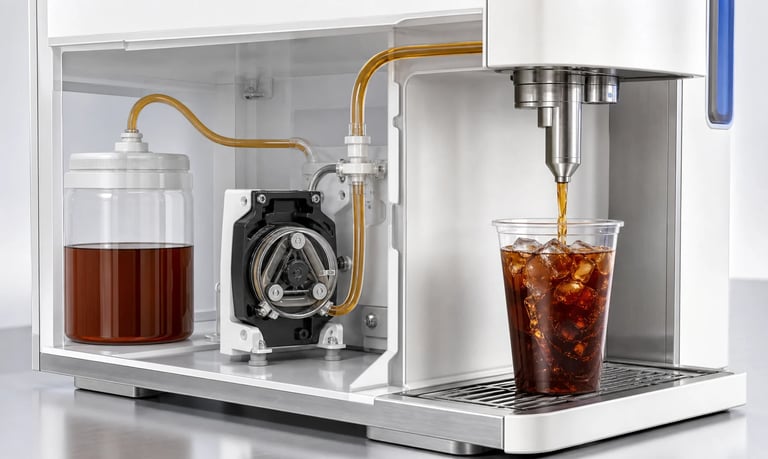
Reliable food and beverage dosing requires a micro pump matched to the ingredient, dose volume, pressure, wetted materials, cleaning process, control method, duty cycle, and maintenance needs of the final equipment.
Micro Pumps for Food and Beverage Dosing Equipment
Food and beverage equipment uses micro pumps to dispense syrup, concentrate, flavor, water, nutrients, cleaning liquids, and other ingredients. Pump selection affects dose consistency, product quality, cleaning, maintenance, noise, and equipment reliability.
The final choice should be based on the exact ingredient and operating system. A pump used successfully with water may deliver a different flow with a viscous syrup, a foaming concentrate, or a liquid containing suspended particles.
Define the Dosing Requirement
Specify the minimum, typical, and maximum dose, the available dispensing time, and the number of cycles per hour or day.
Required active flow = dose volume / dispensing time
Also define acceptable accuracy and repeatability. A pump that is too large may be difficult to control for a small dose, while an undersized pump may require excessive speed or dosing time.
Describe the Ingredient
Provide the complete formulation where possible, including:
Ingredient name and concentration
Viscosity and temperature range
Sugar, oil, alcohol, or acid content
Particles, pulp, or suspended solids
Foaming and bubble behavior
Crystallization or drying tendency
Storage and cleaning exposure
Viscosity may change substantially with temperature. Test the coldest and warmest realistic conditions rather than relying on room-temperature water data.
Choose the Pump Type
Peristaltic Pumps
Peristaltic pumps keep the ingredient inside replaceable tubing. They are often considered for syrup, flavor, concentrate, and additive dosing when an isolated fluid path and straightforward tube replacement are useful.
Flow depends on tube dimensions, speed, viscosity, back pressure, temperature, and tube wear. A preventive tube replacement and calibration plan is required.
Diaphragm Liquid Pumps
Diaphragm pumps provide compact chamber-based transfer and may suit water, cleaning liquid, or compatible ingredients. The medium contacts the diaphragm, valves, chamber, seals, and ports.
Particles, crystals, sticky residue, and bubbles can affect valve sealing and priming. Every wetted material must be evaluated.
Review Wetted Materials and Compliance
Material selection should cover the pump tube or internal chamber, valves, seals, fittings, reservoir, sensors, and nozzle. Compatibility must be verified with the ingredient, cleaning chemicals, concentration, temperature, pressure, and exposure time.
Do not infer food-contact compliance from a material family or pump category. Documentation and regulatory requirements must be confirmed for the specific components and final market.
Account for Pressure and Fluid-Path Resistance
Back pressure may come from narrow tubing, filters, check valves, flow sensors, mixing components, and dispensing nozzles. Viscous ingredients can increase resistance significantly.
Measure flow and dose with the complete fluid path installed. Include a used or loaded filter where its resistance changes during service.
Control Dripping, Siphoning, and Stringing
After the pump stops, gravity, tube elasticity, valve behavior, and nozzle geometry may continue moving liquid. Thick syrups may also form a string rather than a clean drop.
Possible controls include:
Suitable tube occlusion or shutoff valve
Pump reversal or suck-back where validated
Correct nozzle diameter and position
Short outlet tubing
Controlled speed near the end of a dose
Reservoir and outlet height management
Validate the complete dispensing event, not only collected volume over a long period.
Plan Cleaning and Changeover
Cleaning may involve water, detergent, disinfectant, heat, air purge, or tube replacement. The process must reach all wetted surfaces without leaving unacceptable residue.
Avoid dead zones, difficult bends, and fittings that trap ingredients. Confirm that cleaning conditions do not swell tubing, damage valves, reduce seal life, or change calibration.
For product changeover, evaluate carryover and whether a dedicated or replaceable fluid path is needed.
Select the Control Method
Simple equipment may use timed on-off operation. Adjustable dosing can use PWM, analog speed control, stepper motor commands, or digital communication.
For higher accuracy, the equipment may add weight, flow, level, or drop feedback. Calibration should use the actual ingredient and pressure at the intended temperature.
Design for OEM Integration
Check mounting, tube routing, connector access, ventilation, noise, vibration, and service clearance. Pumps inside beverage machines may operate near heat sources, refrigeration zones, moisture, and cleaning spills.
Provide leakage management and keep liquid paths away from unprotected electronics. Make routine tube or module replacement possible without disturbing unrelated components.
Validation Checklist
Minimum and maximum dose
Ingredient viscosity and temperature range
Pressure, nozzle, valves, and filters
Priming and restart after idle periods
Drip, stringing, and suck-back behavior
Cleaning and changeover effectiveness
Tube, valve, and seal life
Noise and heat inside the enclosure
Empty-reservoir and blocked-line faults
Calibration after maintenance
Common Selection Mistakes
Testing only with water
Ignoring cold-fluid viscosity
Assuming all food-related ingredients behave similarly
Using unsupported food-contact or certification claims
Calibrating without the final nozzle and valve
Overlooking syrup crystallization and dried residue
Failing to plan tube or pump-module access
Treating maximum flow as dosing accuracy
Frequently Asked Questions
Which pump is suitable for syrup dosing?
A peristaltic or diaphragm pump may be suitable depending on viscosity, dose, pressure, material compatibility, cleaning, and maintenance. Test the actual syrup and temperature range.
Can a peristaltic pump reduce cross-contamination?
Its fluid remains inside replaceable tubing, which can simplify changeover. The complete reservoir, fittings, nozzle, and handling process still determine contamination control.
How does temperature affect beverage dosing?
Temperature can change viscosity, tube elasticity, valve behavior, flow, and drip characteristics. Calibration should cover expected conditions.
Is a pump automatically food-grade?
No. Compliance depends on the specific wetted components, documentation, final application, cleaning process, and applicable market requirements.
How often should tubing be replaced?
Set the interval from representative life testing, flow drift, inspection, ingredient exposure, cleaning, and application risk.
Kamoer Food and Beverage Equipment Support
Kamoer can help evaluate ingredients, dose, flow, pressure, tubing or wetted materials, cleaning, control, duty cycle, and OEM integration for dispensing equipment.
Related Stories
Kamoer Fluid Tech (Shanghai) Co., Ltd.
pump@kamoer.com