

Micro Pumps for Environmental Monitoring Equipment
APPLICATIONSWATER ANALYSIS WATER TREATMENT
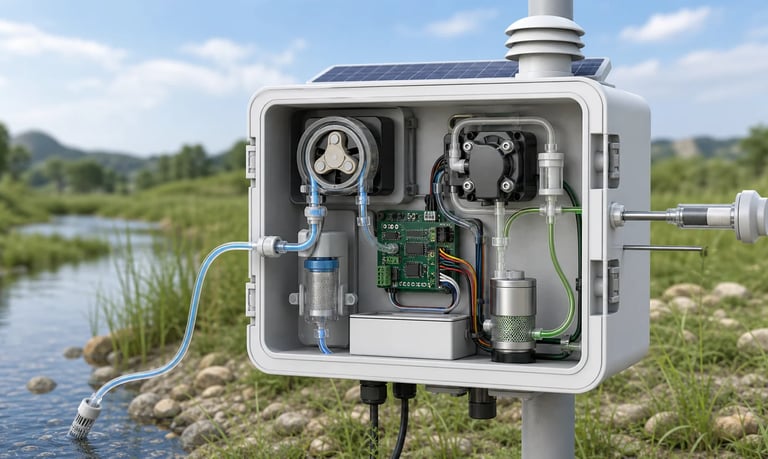
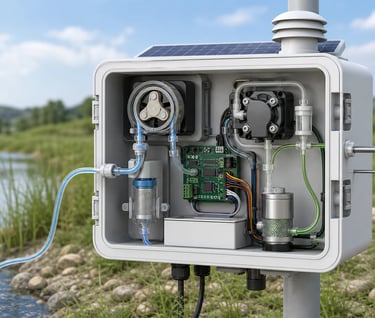
Environmental monitoring reliability depends on micro pumps matched to liquid or gas sampling, target flow, vacuum or pressure, material compatibility, contamination control, filtration, duty cycle, power, climate, and field maintenance.
Micro Pumps for Environmental Monitoring Equipment
Environmental monitoring equipment uses micro pumps to collect water or gas samples, move liquids through sensors, dose reagents, rinse fluid paths, generate vacuum, and remove waste. These systems may operate in remote locations where temperature, humidity, dust, altitude, unstable power, and limited maintenance affect pump performance.
Reliable selection starts with the medium and measurement method. A water sampler, ambient air analyzer, emissions monitor, and reagent-based instrument place different demands on flow, pressure, materials, contamination control, and service life.
Define the Pump Function
Document each required operation:
Water or liquid sample collection
Continuous flow through a sensor cell
Reagent and calibration-liquid dosing
Washing, drainage, and waste transfer
Ambient air or process-gas sampling
Vacuum generation
Pressure supply or pneumatic actuation
Air purging and fluid-path drying
Define minimum, typical, and maximum flow, sampling duration, frequency, startup time, and acceptable variation. For gas systems, specify the required flow at the actual vacuum or pressure.
Select the Pump Technology
Peristaltic Pumps
Peristaltic pumps isolate the liquid inside replaceable tubing. They are often considered for water sampling, reagent dosing, washing, and waste transfer when self-priming, reversible flow, or straightforward fluid-path replacement is useful.
Tubing wear, temperature, back pressure, and chemical exposure must be included in calibration and preventive maintenance.
Diaphragm Liquid Pumps
Diaphragm liquid pumps offer compact chamber-based transfer. They may suit circulation, drainage, cleaning, or compatible sample handling.
Particles, biological growth, crystals, and deposits can interfere with internal valves. All wetted materials require compatibility review.
Diaphragm Gas Pumps
Diaphragm gas pumps are widely used for air sampling, sensor aspiration, vacuum, and pressure. Performance should be evaluated at the required operating point, with the final probe, filter, dryer, tubing, and analysis cell installed.
Moisture and condensate management are important because a gas pump may not be designed for unrestricted liquid ingestion.
Protect Sample Integrity
Pump materials and the fluid path must not introduce unacceptable contamination, adsorption, permeation, or carryover.
For water systems, review tubing, pump chambers, valves, fittings, filters, and bottles against the target analytes. For gas systems, consider adsorption, gas permeability, leaks, outgassing, and reactions with wetted surfaces.
Use representative samples and analytical methods to validate the complete path rather than relying only on general material compatibility data.
Manage Filters and Particles
Environmental samples often contain dust, aerosols, sediment, algae, fibers, or droplets. Filtration protects pumps and sensors but adds resistance that increases as the filter loads.
Define:
Particle or droplet size
Expected loading rate
Filter material and area
Clean and end-of-life pressure loss
Replacement interval
Bypass or blockage detection
Test pump flow with both clean and realistically loaded filters.
Evaluate Flow, Vacuum, and Pressure
Free-flow data does not represent an installed system. Probe lines, filters, valves, sensors, narrow tubing, elevation, dryers, and process pressure shift the pump operating point.
Measure actual flow together with inlet vacuum or outlet pressure. Monitor motor current and temperature at the worst expected restriction.
Critical instruments may use closed-loop flow control or pressure compensation to maintain sampling conditions as filters and ambient pressure change.
Account for Altitude and Weather
Air density and atmospheric pressure change with altitude, affecting gas-pump mass flow, vacuum, and calibration. Temperature changes fluid viscosity, tubing flexibility, valve response, battery capacity, and condensation risk.
Outdoor validation may need to cover:
High and low ambient temperature
Solar heating inside the enclosure
Humidity and condensation
Freezing and thawing
Altitude and atmospheric pressure
Dust, rain, and salt exposure
Transport and installation vibration
Test the pump inside the final enclosure because ventilation and mounting alter heat, noise, and vibration.
Control Moisture and Condensation
Gas sampling lines may collect water vapor or condensate. Liquid droplets can block filters, change measurements, damage sensors, or enter a gas pump.
Possible controls include water traps, hydrophobic filters, heated lines, dryers, drainage, orientation, and moisture detection. Each component adds resistance and should be included in pump sizing.
Plan Power and Control
Remote monitors may operate from batteries, solar supplies, or limited-power systems. Evaluate startup current, typical current at the real operating point, duty cycle, low-voltage behavior, and standby consumption.
Control options may include timed sampling, variable speed, PWM, analog commands, feedback, and digital communication. Software should detect failed priming, blocked filters, empty reservoirs, leaks, or unexpected pressure where practical.
Design for Maintenance
Field maintenance should be predictable and difficult to perform incorrectly.
Provide access to tubing, filters, and pump modules.
Use clear routing and keyed connectors.
Record hours, cycles, pressure, and faults.
Verify flow after service.
Prevent leaks from reaching electronics.
Provide safe flushing and drainage.
Establish replacement intervals from representative tests.
Remote diagnostics can reduce unnecessary site visits by distinguishing an empty source, blocked filter, leak, worn tube, and pump failure.
Validation Checklist
Actual or representative liquid and gas samples
Clean and loaded filters
Minimum and maximum flow
Required vacuum and pressure
Tube length, elevation, and probe restrictions
Temperature, humidity, altitude, and condensation
New and aged tubing, valves, and filters
Continuous and intermittent duty cycles
Power interruption and restart
Empty-source, blocked-line, and leak faults
Sample carryover and cleaning effectiveness
Noise and vibration inside the enclosure
Common Selection Mistakes
Selecting from free-flow data only
Ignoring filter loading and long sample lines
Using a gas pump where liquid ingestion is likely
Testing only at room temperature and sea level
Overlooking adsorption and carryover
Assuming material compatibility without representative analysis
Ignoring condensation and drainage
Omitting battery and low-voltage testing
Failing to provide field-service access
Frequently Asked Questions
Which pump is used for air-quality monitoring?
A diaphragm gas pump is often considered for gas sampling and sensor aspiration. Required flow, vacuum, filter resistance, gas composition, moisture, and altitude determine suitability.
Which pump is used for water monitoring?
Peristaltic and diaphragm liquid pumps can both be used. Select according to sample integrity, particles, suction height, materials, flow, cleaning, and maintenance.
How does a loaded filter affect the pump?
It increases resistance, which can reduce flow and increase vacuum, pressure, motor current, heat, and sampling error.
Can a gas pump handle condensation?
Only when the specific pump and system are designed for it. Water traps, hydrophobic filters, dryers, and drainage may be required.
Does altitude affect gas sampling flow?
Yes. Atmospheric pressure and air density change, so volumetric flow, mass flow, vacuum, and calibration may shift.
Kamoer Environmental Monitoring Support
Kamoer can help evaluate sample type, flow, vacuum, pressure, tubing, wetted materials, filters, moisture, power, climate, duty cycle, and OEM integration for environmental monitoring equipment.
Related Stories
Kamoer Fluid Tech (Shanghai) Co., Ltd.
pump@kamoer.com