

Micro Pumps for Beverage Dispensing Machines
APPLICATIONSFOOD & BEVERAGE
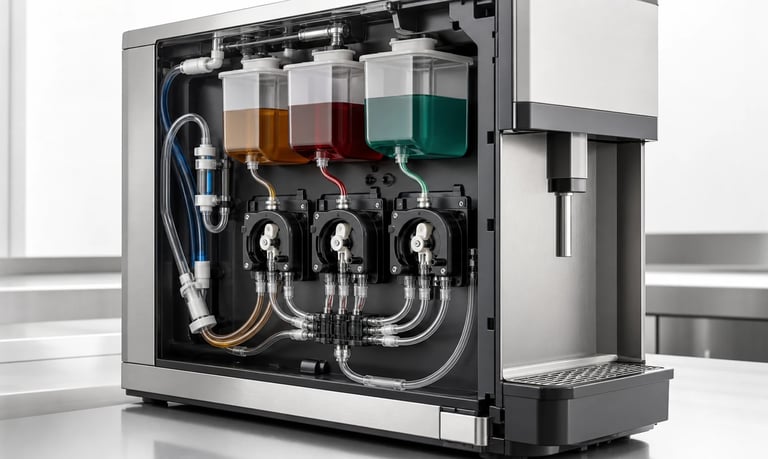
Reliable beverage dispensing depends on micro pumps matched to water, concentrates, flavorings, target dose, pressure, wetted materials, temperature, cleaning, control, noise, duty cycle, and maintenance.
Micro Pumps for Beverage Dispensing Machines
Beverage dispensing machines use micro pumps to move water, concentrates, syrups, flavorings, supplements, cleaning solutions, and waste. The pump affects portion consistency, ingredient ratio, priming time, dripping, noise, sanitation, maintenance, and the overall user experience.
A suitable beverage dispenser pump must be selected for the actual ingredient and installed fluid path. Water test results do not automatically represent a viscous syrup, concentrated flavor, carbonated liquid, dairy-based ingredient, or cleaning chemical. Food-contact and regulatory suitability must also be supported by documentation for the specific pump configuration and market.
Define Every Dispensing Function
Map the complete beverage process before choosing pump hardware:
Transfer water from a tank or supply line
Dose syrup, concentrate, flavor, or supplement
Blend ingredients at a manifold or mixing chamber
Circulate a temperature-sensitive ingredient
Prime lines after refill or container replacement
Flush and rinse the fluid path
Drain a tray or move waste liquid
Supply cleaning or sanitizing solution
For each function, specify minimum, typical, and maximum volume, dispensing time, frequency, direction, and allowed variation. Also define whether ingredients are delivered sequentially or simultaneously and whether the pump must maintain a ratio as the dispensing rate changes.
Select the Pump Type
Peristaltic Pumps
Peristaltic pumps keep the ingredient inside replaceable tubing. They are often considered for concentrated flavor, syrup, additive, and cleaning-fluid dosing when fluid-path isolation, tube replacement, self-priming, or reversible operation is useful.
Delivery depends on tube dimensions, speed, back pressure, viscosity, temperature, and wear. The tubing is a consumable, so calibration and preventive replacement are part of system design.
Diaphragm Liquid Pumps
Compact diaphragm pumps can suit water transfer, compatible beverage circulation, and supply to valves or dispensing points. The fluid contacts the pump chamber, diaphragm, valves, seals, and ports.
Viscous ingredients, particles, deposits, and air can affect valve operation and priming. Test at the required flow and pressure with the actual ingredient.
Other Pump Technologies
Gear, piston, syringe, centrifugal, or pressure-based dispensing systems may be appropriate when viscosity, flow, pressure, dose resolution, shear, or cleaning requirements fall outside the practical range of available micro peristaltic or diaphragm pumps.
No pump technology is universally suitable for all beverage formulations.
Characterize Every Ingredient
Provide formulation details or the engineering properties needed for selection:
Viscosity across the storage and operating temperature range
Density and surface tension
Sugar, acid, alcohol, oil, or solvent content
Suspended pulp, fibers, particles, or crystals
Foaming and air-retention tendency
Sensitivity to shear, oxygen, light, or temperature
Tendency to separate, ferment, dry, or leave sticky residue
Include water, concentrates, rinse fluid, detergent, sanitizer, and mixed waste. A material suitable for the beverage may not tolerate the cleaning sequence.
Compatibility must be verified for every wetted component under actual concentration, temperature, pressure, and exposure time. Also consider adsorption, permeation, extractables, taste, odor, color carryover, and ingredient loss where product quality is sensitive.
Confirm Food-Contact and Regulatory Requirements
Food-contact requirements vary by market, ingredient, temperature, duration, and intended use. Do not infer compliance from a material name or from another pump model.
Before approval, identify:
The target countries or regions
Applicable food-contact requirements
All wetted materials and manufacturing aids
Temperature and contact-time categories
Cleaning and sanitizing chemicals
Required declarations, test reports, or traceability records
Obtain current documentation for the exact pump, tubing, fittings, valves, and seals. Equipment-level hygiene and regulatory compliance remain the responsibility of the final system manufacturer.
Calculate Dose and Flow Range
For a discrete ingredient dose, required active flow is the target volume divided by the available pump run time. For continuous blending, determine the ingredient flow from the desired ratio and total beverage flow.
Define:
Minimum, typical, and maximum portion size
Ingredient ratio and allowed variation
Dispensing time target
Number of servings per hour
Simultaneous channel demand
Prime, flush, and clean-cycle flow
Avoid selecting a pump so large that the smallest dose requires an extremely short command. Motor startup, valve delay, tube recovery, and residual dripping can then become a large part of the delivered volume.
Calibrate with the actual ingredient and complete outlet path. Measure individual doses as well as repeated sequences because average output can hide serving-to-serving variation.
Account for Pressure and Fluid-Path Resistance
Filters, check valves, manifolds, long tubing, narrow fittings, mixers, heat exchangers, and dispensing nozzles create pressure loss. Viscous concentrates can create much more resistance than water, especially at low temperature.
Measure flow and pressure in the assembled system at the minimum and maximum expected ingredient temperature. Include a new filter and a representative loaded condition if filtration is used.
Pump capacity should also cover elevation between the ingredient container and dispensing point. Test all allowed installation configurations rather than assuming a nominal suction height or free-flow rating is sufficient.
Control Priming, Bubbles, and Foam
The inlet path may fill with air after container replacement or a long idle period. Air leaks can also enter through caps, fittings, tube connections, or an empty pickup.
Bubbles are compressible and can reduce dose consistency. Foaming ingredients may retain air and produce an uneven stream or inaccurate volume.
Possible controls include:
Airtight inlet connections
Pickup geometry that remains submerged
Controlled high-speed priming followed by normal speed
Liquid or bubble detection
Prime timeouts and empty-container logic
Reservoir and return geometry that limits aeration
Degassing or bubble separation where appropriate
Validate startup, refill, low-level, tilt, and long-idle conditions using the real ingredient. Water may not reproduce its wetting, foaming, or outgassing behavior.
Prevent Dripping, Siphoning, and Cross-Flow
Liquid movement after the pump stops can change the portion, contaminate the dispensing area, or allow one ingredient to enter another line. Gravity, residual pressure, tube elasticity, valve leakage, nozzle wetting, and container height all contribute.
Controls may include suitable check or shutoff valves, pump suck-back, controlled deceleration, optimized nozzle geometry, tube occlusion, and fluid-path elevation management.
When several ingredients connect to one manifold, evaluate cross-flow during dispensing, idle, cleaning, and container replacement. Each added valve creates resistance and a potential residue trap, so the complete assembly must be tested for both shutoff and cleanability.
Design for Cleaning and Sanitation
Cleaning requirements should be defined before finalizing pump and tubing selection. Sticky concentrates, proteins, oils, pulp, and sugars may remain in dead legs, valve cavities, fittings, or worn tubing.
Develop a validated procedure covering:
Rinse, detergent, sanitizer, and final-rinse fluids
Fluid concentration and temperature
Contact time and flow rate
Required disassembly or part replacement
Drainability and residual liquid
Restart and product-discard volume
Verification method and acceptance criteria
The pump must tolerate the complete cleaning sequence, not only the beverage. If clean-in-place operation is intended, verify that the actual circuit receives sufficient flow and contact without leaving uncleaned pockets. If parts require manual cleaning, make them accessible and difficult to reinstall incorrectly.
Pump selection alone does not establish a hygienic equipment design.
Manage Temperature and Viscosity
Refrigeration can increase ingredient viscosity and pressure loss. Heat from motors, electronics, or warm cleaning cycles can change flow, tubing properties, chemical compatibility, and microbial risk.
Test dispensing after cold storage, during normal operation, and at the highest expected enclosure and cleaning temperatures. Measure the ingredient temperature where it affects the pump rather than relying only on ambient temperature.
If the product can separate or crystallize, define mixing, circulation, warm-up, or discard procedures. Do not assume higher pump speed will correct every viscosity or deposit problem.
Choose the Control and Calibration Strategy
Simple machines may run a DC pump for a fixed time. More advanced equipment can use PWM, analog speed commands, stepper motion, or closed-loop feedback.
Useful control functions include:
Fast prime and controlled dispense profiles
Recipe-based speed and time settings
Ratio control across multiple ingredient channels
Slow finish to reduce splash and dripping
Suck-back or valve closure at stop
Empty-container, blockage, leak, or failed-prime detection
Automated rinse and cleaning sequences
Timed control can be repeatable under stable conditions, but voltage, viscosity, temperature, pressure, air, tube wear, and valve condition can change delivery. Closed-loop systems may use flow, weight, level, pressure, or other feedback when process requirements justify the added complexity.
Calibration should cover the full dose range, temperature range, container level, pressure variation, new and aged service parts, and representative ingredient lots. Define recalibration after tube, pump, valve, or formulation changes.
Control Noise, Power, and Heat
Countertop and self-service dispensers may operate near customers, so pump noise and vibration should be evaluated inside the final enclosure. Panels, tanks, shelves, and rigid tubing can amplify structure-borne sound.
Resilient mounts, flexible connections, suitable pump speed, and adequate clearance may reduce transmitted vibration. Confirm that mounting remains secure during transport and service.
Measure startup and operating current at the actual pressure and viscosity. Include simultaneous pumps, low supply voltage, repeated servings, prime cycles, and warm enclosure conditions in electrical and thermal testing.
Plan Preventive Maintenance
Service intervals should be based on representative testing with the actual beverage, cleaning fluids, speed, pressure, temperature, and duty cycle.
Replace tubing, filters, valves, seals, or other service parts before predictable failure.
Inspect for leaks, swelling, hardening, discoloration, residue, and loss of elasticity.
Verify dose and ingredient ratio after service.
Record cycles, run time, faults, and calibration history.
Protect electronics with containment and drainage.
Make fluid lines identifiable without relying on color alone.
Design maintenance so a technician cannot easily reverse a line, leave a fitting loose, or bypass a required cleaning step.
Validation Checklist
Every beverage ingredient, cleaner, sanitizer, rinse fluid, and mixed waste
Minimum and maximum dose and flow
Full ingredient temperature and viscosity range
New and loaded filters
Minimum and maximum container level and elevation
Empty-line priming and refill conditions
Bubbles, foam, inlet leaks, and failed priming
Nozzle, valve, manifold, and mixer pressure loss
Drip, siphon, suck-back, and cross-flow behavior
Individual and simultaneous pump operation
New and aged tubing, valves, diaphragms, and seals
Cleaning, drainage, idle, storage, and restart sequences
Portion accuracy and ingredient ratio over service life
Noise, current, heat, leak, blockage, and power-loss faults
Required food-contact documentation for the final configuration
Common Selection Mistakes
Selecting from water and free-flow data only
Ignoring low-temperature syrup viscosity
Treating food-contact suitability as automatic for a material family
Testing the beverage but not the cleaner or sanitizer
Sizing only for maximum flow and losing small-dose resolution
Overlooking pressure loss through valves, filters, and mixers
Ignoring air entry after container replacement
Adding shutoff valves without checking cleanability
Evaluating dose only when tubing and valves are new
Making service parts difficult to access or reconnect correctly
Frequently Asked Questions
Which pump is best for a beverage dispenser?
There is no universal best pump. Peristaltic pumps often suit isolated ingredient dosing, while diaphragm pumps can suit water or compatible liquid transfer. Ingredient properties, dose, pressure, cleaning, documentation, and maintenance determine the choice.
Can one pump dispense both water and syrup?
Possibly, but viscosity, flow range, pressure loss, materials, cleaning, and dose requirements differ. Test each ingredient and do not assume water performance represents syrup delivery.
How can a dispenser improve portion accuracy?
Use a suitable pump operating range, stable pressure, controlled priming, calibrated speed and time, and feedback where needed. Validate across temperature, container level, ingredient lots, and service-part age.
Why does a beverage nozzle drip after dispensing?
Residual pressure, gravity, siphoning, tube recovery, valve leakage, and nozzle wetting can continue moving liquid. A valve, suck-back sequence, controlled stop, or nozzle change may help after system-level testing.
Does a food-grade tube make the whole machine compliant?
No. Every wetted component, the actual contact conditions, manufacturing process, documentation, and final equipment design must meet the requirements of the intended market and use.
Kamoer Beverage Dispensing Support
Kamoer can help evaluate ingredient properties, dose range, flow, pressure, tubing, wetted materials, priming, bubbles, cleaning, control, calibration, noise, duty cycle, and OEM integration for beverage dispensing machines.
Related Stories
Kamoer Fluid Tech (Shanghai) Co., Ltd.
pump@kamoer.com