

Micro Pumps for Automated Reagent Dosing
APPLICATIONSLABORATORY AUTOMATION
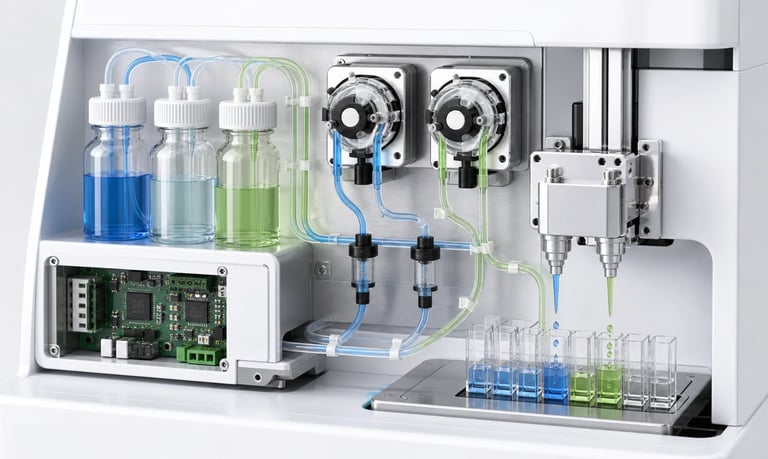
Accurate automated reagent dosing depends on micro pumps matched to dose volume, timing, fluid chemistry, bubbles, pressure, wetted materials, calibration, feedback control, duty cycle, and preventive maintenance.
Micro Pumps for Automated Reagent Dosing
Automated analyzers, laboratory instruments, treatment systems, and industrial devices use micro pumps to dispense reagents in controlled volumes. Pump selection influences dose accuracy, repeatability, carryover, bubble handling, maintenance, and total system reliability.
A suitable dosing pump must be evaluated with the actual reagent and fluid path. Nominal flow measured with water does not guarantee the same dose with a viscous, volatile, corrosive, or crystallizing liquid.
Define the Dose
Specify:
Minimum, typical, and maximum dose
Allowed dispensing time
Doses per hour or day
Accuracy and repeatability requirements
Adjustable or fixed dosing range
Delay allowed before measurement or reaction
The required active flow is dose volume divided by available dosing time. Avoid selecting a pump so large that the minimum dose requires an extremely short run time.
Select the Pump Type
Peristaltic Pumps
Peristaltic pumps keep the reagent inside replaceable tubing. They are often considered when fluid isolation, tube replacement, self-priming, or reversible flow is useful.
Dose depends on tube dimensions, speed, pressure, viscosity, temperature, and wear. Calibration and preventive tube replacement are required.
Diaphragm Liquid Pumps
Diaphragm pumps provide compact internal transfer and can suit reagent movement when the dose and operating point match the design. The reagent contacts the diaphragm, valves, chamber, seals, and ports.
Crystals, particles, bubbles, and deposits can affect valve sealing. Simple transfer pumps may require additional control or feedback for precise dosing.
Other Metering Options
Syringe, piston, piezoelectric, or valve-controlled pressure systems may be considered when dose resolution, pressure, or fluid behavior falls outside the practical range of available peristaltic or diaphragm pumps.
Describe the Reagent
Provide chemical name, concentration, temperature, viscosity, volatility, surface tension, particles, and crystallization tendency. Include cleaning and rinsing fluids.
Compatibility must cover every wetted component under actual concentration, temperature, pressure, and exposure time. Also consider adsorption, permeation, and extractables when analytical sensitivity matters.
Control Bubbles
Bubbles are compressible and can reduce delivered liquid volume. They may result from inlet leaks, outgassing, empty reservoirs, foaming, or poor reservoir geometry.
Possible controls include sealed inlet paths, bubble sensors, degassing, controlled priming, liquid detection, reservoir designs that prevent vortexing, and software timeouts.
Validate dosing after startup, reservoir replacement, and long idle periods.
Account for Back Pressure
Filters, check valves, sensors, narrow tubing, probes, and dispensing nozzles create resistance. Pressure can change flow, tube expansion, valve operation, dripping, and motor load.
Calibrate with the final nozzle and downstream components installed. Test minimum and maximum expected restriction.
Prevent Dripping and Siphoning
A small residual drop can be significant relative to a micro dose. Gravity, tube elasticity, nozzle wetting, valve leakage, and reservoir height may continue moving liquid after the pump stops.
Controls may include suitable tube occlusion, shutoff valves, pump suck-back, optimized nozzle geometry, controlled end speed, and fluid-path elevation management.
Choose the Control Strategy
Timed Operation
Running at a fixed speed for a defined time is simple but sensitive to voltage, pressure, viscosity, temperature, and wear.
Step or Speed Control
Stepper motors, PWM, or analog speed commands improve motion resolution and enable fast-fill and slow-finish profiles. Fluid delivery still requires calibration.
Closed-Loop Dosing
Flow, weight, pressure, level, or drop feedback can improve control and detect faults. Sensor delay, resolution, wetted materials, and added restriction must be included in the design.
Build a Calibration Plan
Calibrate with the actual reagent, tubing, fittings, pressure, temperature, and control sequence. Measure individual doses and repeated series.
Cover:
Minimum and maximum dose
Reservoir level range
Temperature range
New and aged tubing or valves
Pressure and nozzle variation
Startup and long-idle conditions
Reagent lot or viscosity variation
Define when recalibration is required after maintenance or fluid-path replacement.
Detect Dosing Faults
Useful detection methods include:
Bubble or liquid sensing
Flow measurement
Weight verification
Pressure monitoring
Reservoir level sensing
Motor current or stall detection
Maximum run-time limits
Fault logic should distinguish an empty reservoir, blocked outlet, inlet leak, worn tube, failed valve, and sensor error where practical.
Plan Maintenance
Replace tubing or service parts before predictable failure.
Flush reagents that crystallize or leave residue.
Inspect fittings and valves for leaks or deposits.
Verify dose after service.
Record cycles, run time, faults, and calibration history.
Protect electronics with containment and leak detection.
Validation Checklist
Actual reagent and cleaning fluids
Full dose and temperature range
Bubbles and failed priming
Minimum and maximum pressure
New and aged fluid-path parts
Drip, siphon, and suck-back behavior
Continuous and peak duty cycle
Empty, blocked, leak, and power-loss faults
Calibration stability over life
Frequently Asked Questions
Which pump is best for reagent dosing?
There is no universal best option. Peristaltic pumps often suit isolated replaceable fluid paths, while diaphragm pumps can suit compact transfer. Dose, fluid, pressure, control, and maintenance determine the choice.
How do bubbles affect a dose?
Air compresses and occupies fluid-path volume, so the commanded pump movement may deliver less liquid than expected.
Can timed operation provide accurate dosing?
It can be repeatable under stable conditions, but changes in pressure, viscosity, temperature, voltage, and wear can alter delivery.
Why does reagent flow decrease over time?
Tube fatigue, filter loading, crystallization, valve deposits, viscosity changes, and leaks are common causes.
How often should calibration be checked?
Set the interval from required accuracy, life-test data, fluid behavior, maintenance events, and process risk.
Kamoer Reagent Dosing Support
Kamoer can help evaluate dose range, reagent compatibility, tubing, pressure, bubbles, control, calibration, duty cycle, fault detection, and OEM integration for automated dosing systems.
Related Stories
Kamoer Fluid Tech (Shanghai) Co., Ltd.
pump@kamoer.com