

How Tube Inner Diameter Affects Peristaltic Pump Flow
TUBING & CHEMICAL

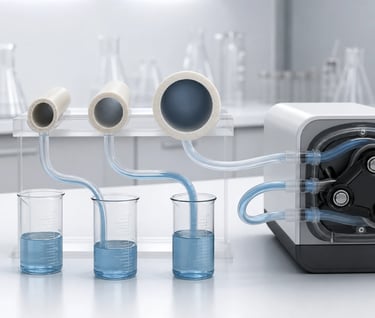
Peristaltic tube inner diameter changes the liquid volume available for each roller movement, but actual flow also depends on wall thickness, outside diameter, occlusion, tube recovery, speed, inlet refill, outlet pressure, viscosity, tolerances, and calibration.
How Tube Inner Diameter Affects Peristaltic Pump Flow
Tube inner diameter is one of the main factors that determines peristaltic pump displacement. A larger bore contains more liquid along the compressed pump track, so it can usually deliver more volume per revolution. A smaller bore can support lower flow and finer dose increments.
The relationship is not a complete pump specification. Wall thickness, outside diameter, tube elasticity, occlusion, roller geometry, speed, inlet refill, outlet pressure, fluid viscosity, temperature, and manufacturing tolerances all affect actual output.
Changing only the nominal inner diameter may also change tube fit, motor load, pressure capability, pulsation, prime time, retained volume, and service life. The new tube must be approved for the pump head and validated in the complete fluid path.
Understand the Geometric Relationship
The cross-sectional area inside a round tube is:
Tube area = π × inner diameter² / 4
If every other factor remained constant, the liquid volume along a given tube length would increase with the square of inner diameter. An approximate displacement concept is:
Theoretical displaced volume = tube area × effective swept length
This relationship is useful for early comparison, but peristaltic pumping does not move a perfectly rigid cylinder of liquid. The tube is repeatedly flattened and reopened. Roller entry and exit, tube deformation, occlusion, slip, pressure, and refill change the effective trapped volume.
Do not estimate a new production flow only by multiplying the old flow by the ratio of squared inner diameters. Use the calculation for screening, then measure the approved tube in the actual pump.
Distinguish Inner Diameter, Outside Diameter, and Wall Thickness
Tube dimensions are related:
Wall thickness = (outside diameter - inner diameter) / 2
Two tubes can have the same inner diameter but different outside diameters and wall thicknesses. They may fit and behave very differently in a pump head.
Inner diameter primarily affects fluid area and resistance. Outside diameter and wall thickness influence:
Fit in the pump track and tube guides
Compression and effective occlusion
Motor torque and current
Tube recovery after roller release
Resistance to inlet collapse and outlet expansion
Heat generation and flex-fatigue behavior
Retention in fittings and clamps
A tube selected only by inner diameter may be under-compressed, over-compressed, or mechanically incompatible with the pump head.
Use the exact approved combination of inner diameter, outside diameter, wall thickness, material, and formulation.
Larger Inner Diameter Usually Increases Flow per Revolution
With a compatible tube and pump head, a larger inner diameter generally increases the amount of liquid displaced per roller event and per revolution. This can deliver a target flow at lower rotor speed.
Potential benefits include:
Higher maximum flow
Lower motor speed for a given average flow
Shorter transfer or priming time
Reduced pressure loss in external tubing of the same larger bore
A possible shift away from a noisy high-speed operating point
Potential tradeoffs include:
Larger minimum dose increment
Greater pulsation volume per roller event
More retained liquid
More liquid released after stop if the outlet is compliant
Larger fittings and fluid-path volume
Different torque, occlusion, and pressure behavior
The larger tube may not reach its theoretical flow advantage if the inlet, fittings, reservoir pickup, valves, or nozzle remain restrictive.
Smaller Inner Diameter Supports Lower Flow and Finer Doses
A smaller bore contains less liquid per unit length, so each rotor movement can deliver a smaller amount. This may help low-flow and small-dose applications.
However, smaller passages create higher fluid resistance. At a given flow, pressure loss can rise sharply as diameter decreases. The result may be:
Higher inlet vacuum
Higher outlet pressure
Slower priming
Reduced flow with viscous fluid
Greater sensitivity to particles and bubbles
More pressure stored in flexible sections
A smaller usable high-speed range
A smaller tube does not automatically improve dosing accuracy. If the motor must run at very high speed, the tube cannot refill, the nozzle requires high pressure, or the measurement resolution is inadequate, repeatability may worsen.
Select the bore by balancing displacement, pressure loss, fluid behavior, dose timing, and pump-head compatibility.
Inner Diameter Affects Dose Resolution
Motor command resolution and fluid resolution are different. A stepper can command small angular increments, but the smallest repeatable liquid dose depends on the tube and fluid path.
Larger inner diameter increases volume per rotor angle, so one step, encoder count, or unit of run time represents more liquid. Smaller inner diameter reduces this amount.
Actual dose resolution is also limited by:
Partial roller-cycle behavior
Tube elasticity and recovery
Gearbox backlash or motor coast
Acceleration and deceleration
Outlet pressure and compliant volume
Bubbles
Nozzle wetting and drop formation
Balance or sensor resolution
Measure individual doses at the minimum command. Do not calculate minimum dose from geometric tube area alone.
If a small tube cannot meet dispense time or pressure requirements, a larger tube with slower controlled motion may still produce better practical dosing.
Inner Diameter Changes External Pressure Loss
Tube bore strongly affects resistance to flow. For simple laminar flow in a straight rigid round tube, pressure loss depends on viscosity, length, flow, and diameter. The diameter effect is strong enough that a small bore reduction can create a large resistance increase.
Real pump systems include flexible tubing, fittings, contractions, valves, filters, sensors, pulsation, and sometimes non-Newtonian fluids. Use fluid calculations to understand trends, then measure the complete path.
When comparing tubes, include:
Full inlet and outlet length
Fitting and valve bore
Filters in clean and loaded states
Nozzle or needle restriction
Elevation
Minimum and maximum viscosity
Flow range
Increasing the pump-head tube diameter while leaving narrow external fittings can move the dominant restriction elsewhere without delivering the expected flow increase.
Inlet Refill Can Limit the Benefit of a Larger Bore
After a roller passes, the tube must reopen and draw in liquid. A larger tube can displace more per cycle, but it also requires more liquid to enter during the available refill time.
Incomplete refill is more likely with:
High rotor speed
High viscosity
Cold fluid
Long or small-bore inlet tubing
Narrow fittings or filters
High suction lift
Poor reservoir venting
Soft inlet tubing that collapses
Slow tube recovery
When refill becomes incomplete, increasing speed no longer produces proportional flow. The speed-to-flow curve flattens, dose variation may increase, and bubbles or low-pressure effects can appear.
Measure inlet vacuum and observe tube recovery at the worst reservoir level, fluid temperature, viscosity, and speed. A larger pump tube may require a larger, shorter external inlet path.
Wall Thickness and Recovery Affect Actual Displacement
The peristaltic tube must recover after compression. Wall thickness, material, hardness, formulation, temperature, chemical exposure, and age all affect recovery.
A tube with the same inner diameter but different wall construction may reopen faster, resist collapse better, or require more compression force. It may also trap a different effective volume in the pump track.
Slow recovery can cause:
Reduced flow at higher speed
Increased sensitivity to inlet vacuum
Nonlinear speed response
More first-dose or startup variation
Permanent flattening over time
Excessive wall thickness or stiffness can increase roller force, motor current, heat, and tube fatigue if the pump head is not designed for it.
Evaluate the complete dimensional and material specification rather than substituting a tube that merely has the same bore.
Occlusion Must Match the Tube
Occlusion is the amount of tube compression between the roller and track. Proper occlusion separates inlet and outlet volumes and limits slip or backflow.
Changing inner diameter often means changing wall thickness or outside diameter, which changes effective occlusion. Too little occlusion may cause low or pressure-dependent flow, loss of prime, backflow, or siphoning. Too much may raise motor load, heat, tube wear, and particle generation.
For adjustable pump heads, use only the approved setup range. Do not increase compression simply to recover theoretical flow.
Verify:
Flow at minimum and maximum pressure
Motor current and pump-head temperature
Leakage and backflow
Tube condition and life drift
Performance across dimensional tolerances
A nonadjustable pump head still requires an approved tube dimension. It is not automatically compatible with every tube that can physically be inserted.
Inner Diameter Affects Pressure Capability Indirectly
Pressure performance cannot be inferred from inner diameter alone. Tube material, outside diameter, wall thickness, temperature, chemical exposure, occlusion, fittings, and cyclic compression all matter.
A larger inner diameter with the same outside diameter has a thinner wall. This may change expansion, strength, fitting retention, and fatigue behavior. A larger tube with the same wall thickness also has a larger outside diameter and may not fit the pump head.
Under outlet pressure, flexible tubing can expand and store volume. This can reduce instantaneous delivery, increase post-stop dripping, and change pulsation.
Test normal pressure, maximum restriction, valve switching, blockage, and residual pressure with new and aged tubing. Use pressure limits approved for the exact pump-tube configuration and temperature.
Inner Diameter Changes Pulsation
Peristaltic pumps deliver liquid in cyclic trapped volumes. A larger inner diameter generally increases the volume associated with each roller event. At the same speed, absolute pulse volume and pressure response may therefore change.
At the same average flow, a larger tube can operate more slowly, which lowers pulse frequency. A smaller tube may require higher speed, creating more frequent, smaller displacement events. Which output appears smoother depends on pump-head geometry, tube compliance, fluid resistance, and the process measurement window.
Evaluate:
Peak-to-peak flow or pressure
Pulse frequency
Average flow
Nozzle or spray output
Sensor behavior
Short-dose repeatability
Do not assume a smaller bore always produces lower percentage pulsation or that a larger bore always makes it worse. Measure at equal required average flow and pressure.
Inner Diameter Affects Priming and Bubbles
Larger tubing contains more internal volume, so it may require more total liquid to fill the path. It may still prime faster if its lower resistance permits much higher flow.
Smaller tubing uses less volume but can restrict air and liquid movement, especially with viscous fluid. Small bubbles may occupy a larger fraction of the cross-sectional area and have a greater effect on dose.
Tube diameter also influences:
Bubble velocity and coalescence
High-point gas trapping
Reservoir pickup behavior
Nozzle drop size
Drainage after stop
Waste generated during priming and cleaning
Test dry prime, wet restart, partial prime, low reservoir, and the longest idle condition. Use the production tube routing and fittings.
If bubble sensitivity is critical, diameter selection should be evaluated with fluid surface tension, wetting, viscosity, dissolved gas, and orientation.
Inner Diameter Affects Retained Volume and Cleaning
Internal volume increases with tube area and length. A larger bore can retain more product, cleaner, rinse liquid, or mixed waste.
This affects:
Prime and purge consumption
Product changeover
Cleaning-fluid volume
Drainage time
Residence time
Cross-contamination risk
Fluid wasted during tube replacement
A smaller bore reduces volume but may be harder to flush at sufficient flow or may trap viscous residue because of pressure limitations.
Validate cleaning using the actual product, cleaner, temperature, flow, contact time, direction, and drainage sequence. Clear rinse at the outlet does not prove that all residue has been removed.
Avoid unnecessary diameter changes, dead legs, and fittings with internal cavities that cannot be reached by cleaning flow.
Account for Viscosity and Non-Newtonian Fluids
High viscosity increases pressure loss and slows inlet refill, making diameter selection more important. A tube that works with water may deliver much less flow with syrup, oil, gel, adhesive, concentrated reagent, or cold detergent.
For non-Newtonian fluids, apparent viscosity changes with shear rate and time. A larger tube may reduce shear rate in part of the path, while restrictions and pump compression create different local conditions.
Document:
Viscosity with temperature and measurement method
Shear-thinning, shear-thickening, or thixotropic behavior
Yield stress
Particles, fibers, crystals, or bubbles
Separation, settling, curing, or drying
Do not apply a water-derived diameter-to-flow ratio to a complex fluid. Test the actual product or a justified representative across the full temperature and pressure range.
Account for Manufacturing Tolerances
Nominal inner diameter is not the only dimension. Actual bore, wall thickness, outside diameter, ovality, hardness, and elasticity vary within manufacturing tolerances.
Because area depends on the square of diameter, bore variation can contribute to flow variation. The combined effect of inner diameter, wall thickness, occlusion, and material response may be larger than one dimensional tolerance suggests.
Evaluate:
Multiple tube samples and lots
Minimum and maximum relevant dimensions
Pump-head and roller tolerances
Tube hardness and recovery
Fitting and clamp variation
Installation differences
Measure flow and dose with production-representative combinations. If the application requires tight accuracy, individual calibration, lot control, incoming inspection, or a narrower tube specification may be necessary.
Do not create an unnecessarily tight drawing tolerance without confirming that suppliers can measure and control it consistently and that it materially improves system performance.
Calibrate Every Approved Tube Configuration
Changing inner diameter changes volume per revolution, so the calibration factor must be updated and verified.
For each approved tube configuration, record:
Part number, dimensions, material, and lot
Pump head and occlusion setting
Fluid and temperature
Pump speed or motion profile
Inlet and outlet pressure
Flow or repeated dose measurements
Calibration coefficient and valid range
Tube condition and run-in procedure
Do not use one coefficient for different tube sizes unless testing proves the control system applies the correct configuration-specific model.
Protect against selecting the wrong tube in production or service. Mechanical keying, labels, controlled kits, software configuration checks, and end-of-line flow testing can reduce risk.
After tube replacement, verify seating, head closure, priming, leakage, flow, and calibration.
Choose the Diameter with a System Test
Early calculations can narrow the choices. Final selection requires measured comparison.
Test candidate tubes at:
Minimum, typical, and maximum flow
Minimum and maximum dose
Full speed range
Minimum and maximum outlet pressure
Worst inlet restriction and reservoir level
Minimum and maximum fluid temperature
Full viscosity range
New, run-in, and representative aged condition
Minimum and maximum supply voltage
Cleaning and idle conditions
Record flow, dose, inlet vacuum, outlet pressure, motor current, speed, pump-head temperature, prime time, pulsation, bubbles, leakage, and tube condition.
Compare candidates at the same application output, not merely at the same motor speed. A larger tube at lower speed and a smaller tube at higher speed create different pressure, pulsation, heat, noise, and wear conditions.
Tube-Diameter Selection Checklist
Required flow, dose, timing, and pressure defined
Inner diameter, outside diameter, wall thickness, and material specified
Theoretical area relationship used only for screening
Tube approved for the pump head and guide geometry
Occlusion checked across pump and tube tolerances
Motor torque, current, and temperature measured
Speed-to-flow curve recorded across the required range
Inlet refill and vacuum checked at maximum viscosity
Outlet pressure loss measured with production components
Dose resolution verified with actual liquid
Pulsation evaluated at equal required flow
Prime time, bubbles, retained volume, and post-stop delivery checked
Pressure, blockage, fittings, and leakage validated
Cleaning, drainage, and product changeover evaluated
Multiple tube lots and dimensional conditions tested
New, run-in, aged, and chemically exposed tubing compared
Calibration stored and protected for each approved tube
Production and service controls prevent incorrect substitution
Common Tube-Diameter Mistakes
Predicting flow only from inner diameter squared
Ignoring outside diameter and wall thickness
Installing any tube that physically fits the pump head
Changing bore without checking occlusion
Comparing tube sizes at the same speed instead of the same required flow
Expecting a larger tube to overcome narrow fittings
Increasing speed when a large tube cannot refill
Assuming a smaller tube always improves dosing accuracy
Ignoring pressure loss with viscous fluid
Using nominal dimensions without production tolerances
Reusing the calibration factor from another tube size
Testing only new tubing
Ignoring retained volume and cleaning waste
Selecting from static pressure data instead of cyclic pump testing
Frequently Asked Questions
Does doubling tube inner diameter quadruple peristaltic pump flow?
Tube area increases with diameter squared, but actual pump flow also depends on wall thickness, occlusion, roller geometry, tube recovery, pressure, viscosity, refill, and speed. Measure the real configuration.
Does a larger tube always increase maximum flow?
Usually it increases displacement per revolution, but inlet restrictions, incomplete refill, motor torque, pump-head compatibility, and outlet pressure may limit the benefit.
Is a smaller tube better for accurate dosing?
It can reduce volume per motor movement, but higher resistance, bubbles, partial roller cycles, motor control, and measurement resolution also affect accuracy.
Can tubes with the same inner diameter be interchangeable?
Not necessarily. Outside diameter, wall thickness, material formulation, hardness, recovery, tolerances, chemical compatibility, and pump-head fit may differ.
Why does flow become nonlinear at high speed with a larger tube?
The tube may not refill completely between roller passes because the inlet path cannot supply the required liquid volume quickly enough.
Must the pump be recalibrated after changing tube diameter?
Yes. A diameter change alters volume per revolution and system resistance. Calibrate and verify the complete approved tube configuration across its operating range.
Kamoer Tube and Pump-Head Selection Support
Kamoer can help evaluate tube inner diameter, wall thickness, pump-head fit, occlusion, motor load, flow range, dose resolution, pressure, refill, fluid properties, calibration, and representative tubing tests.
Related Stories
Kamoer Fluid Tech (Shanghai) Co., Ltd.
pump@kamoer.com