

How to Select Tubing for Chemical Dosing
TUBING & CHEMICAL
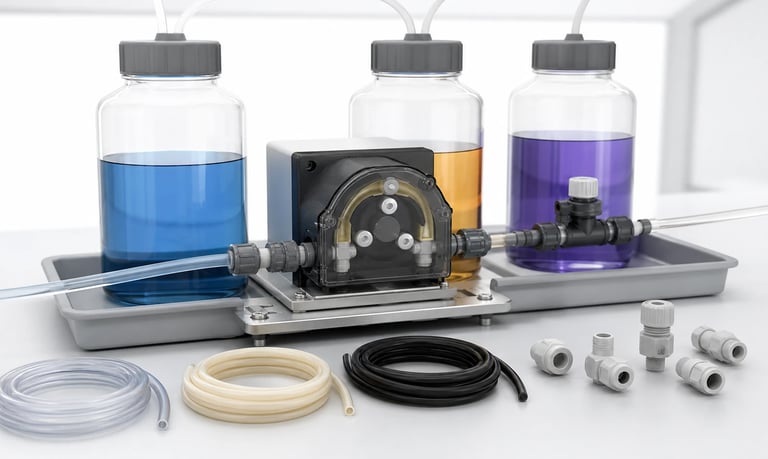
Reliable chemical dosing tubing selection depends on the exact chemical and concentration, temperature, pressure, exposure time, tubing formulation and dimensions, permeation, fitting retention, pump compression, cleaning process, containment, and representative life testing.
How to Select Tubing for Chemical Dosing
Chemical dosing tubing carries concentrated or diluted chemicals between containers, pumps, valves, sensors, and injection points. It may also serve as the pumping element inside a peristaltic pump. A tubing failure can change the dose, admit air, damage equipment, contaminate a process, or expose personnel and the environment.
Selection cannot be based on the polymer name alone. The exact formulation, dimensions, chemical concentration, temperature, pressure, exposure time, mechanical stress, cleaning procedure, and fitting design must all be evaluated.
Define the Complete Chemical Exposure
Start with the complete fluid list:
Production chemical and concentration range
Carrier or dilution fluid
Cleaning and rinsing agents
Calibration fluids
Reaction by-products
Mixed waste
Foreseeable contaminants
Record minimum and maximum temperature, pressure, exposure duration, dosing frequency, and whether the tubing remains filled during standby.
Chemical compatibility can change with concentration and temperature. A tube that performs with a dilute solution at room temperature may behave differently with concentrate, warm cleaning fluid, or long idle exposure.
Identify the Tubing Function
Tubing requirements depend on where it is used:
Peristaltic pump tube under repeated compression
Suction line from a chemical container
Pressure line to an injection point
Drain or waste line
Vent or vapor line
Replaceable cartridge or single-use assembly
A material suitable as stationary transfer tubing may not survive cyclic compression in a peristaltic pump. Likewise, flexible pump tubing may not provide the pressure rating, permeation control, or fitting retention needed for a long discharge line.
Define each segment separately rather than forcing one tubing type throughout the system.
Use Compatibility Data as Screening
Supplier compatibility charts are useful for narrowing options, but ratings may be based on immersion, unstressed samples, limited temperatures, or a different formulation.
Confirm:
Exact tubing manufacturer and grade
Chemical name and composition
Concentration
Temperature
Test duration
Rating criteria
Whether mechanical stress was included
Different grades within silicone, thermoplastic elastomer, fluoropolymer, FKM, or other families can behave differently. Do not transfer a rating between formulations without supporting data.
After screening, test the exact tube under representative pumping and system conditions.
Look Beyond Visible Chemical Attack
Failure may occur without obvious dissolution. Inspect and measure for:
Swelling or shrinkage
Softening or hardening
Cracking or crazing
Tackiness or surface change
Discoloration
Mass or dimension change
Loss of tensile strength
Loss of elastic recovery
Increased permeability
Extractables or contamination
For peristaltic tubing, even a small change in hardness or recovery can alter flow, occlusion, motor load, and fatigue life.
Consider Concentration and Dilution Points
Where a concentrate enters a water or process stream, the tubing upstream of mixing sees a different chemical condition from the downstream path. Poor mixing may also create local high-concentration zones.
Identify where dilution occurs and whether backflow can expose upstream tubing to process fluid. Check valve leakage, diffusion, siphoning, or shutdown conditions may change the actual exposure.
If the chemical releases heat when diluted, evaluate the local temperature at the injection and mixing point rather than only the reservoir temperature.
Account for Temperature
Temperature affects chemical reaction rate, tubing strength, flexibility, pressure capability, permeation, and peristaltic recovery. Include:
Cold startup
Normal process temperature
Maximum enclosure temperature
Heated chemicals
Exothermic dilution
Cleaning and sanitizing cycles
Transport and storage extremes
Use the supplier's data for the exact tube grade, but validate the combined chemical and mechanical condition. Maximum temperature in air does not prove suitability while pumping a chemical under pressure.
Choose Inner Diameter and Wall Thickness
Inner diameter affects flow, pressure loss, dose per revolution, prime time, and retained volume. Wall thickness influences pressure resistance, fitting retention, flexibility, and peristaltic occlusion.
Small tubing reduces internal volume but may create high resistance with viscous chemicals or long runs. Large tubing reduces resistance but can increase chemical inventory, waste, and response time.
For peristaltic pumps, use dimensions supported by the pump head. A nominal size with the wrong wall thickness may not occlude correctly and can produce backflow, excess motor load, or rapid wear.
Review dimensional tolerance as well as nominal values because variation can affect dose and fitting security.
Evaluate Pressure and Vacuum
Chemical dosing systems may include suction lift, filters, check valves, long tubing, injection valves, and pressurized process lines.
On the inlet side, excessive vacuum can collapse soft tubing, slow refill, and draw air through imperfect fittings. On the outlet side, pressure can expand tubing, reduce dose accuracy, stress connections, and increase leakage risk.
Verify pressure and vacuum capability at the actual temperature and chemical exposure. Ratings may decrease as temperature rises or after material changes.
Test blockage, closed-valve, failed-injection, and siphoning conditions. Provide pressure relief or safe shutdown where the risk requires it.
Check Permeation and Vapor Loss
Some chemicals, solvents, gases, and vapors can permeate through tubing. Consequences may include:
Concentration change
Odor or vapor release
Oxygen or moisture ingress
Loss of volatile components
Exposure inside the equipment enclosure
Cross-contamination between adjacent lines
Permeation depends on tubing material, wall thickness, surface area, temperature, concentration, and time. Chemical resistance does not automatically mean low permeability.
Evaluate the complete expected line length and idle time. Where vapor exposure matters, include ventilation, detection, containment, or a lower-permeation barrier tube as appropriate.
Match Tubing to Fittings
Fittings and retention are part of tubing selection. Tube inner diameter, outer diameter, hardness, wall thickness, surface friction, and chemical swelling affect connection security.
Evaluate barbs, clamps, compression fittings, push-to-connect fittings, ferrules, and threaded adapters according to the tube and pressure condition.
Define insertion depth, clamp location, torque, assembly method, and inspection criteria. Avoid sharp edges that cut the tube and side loads that stress pump ports or fittings.
Perform pull, pressure, vacuum, temperature-cycle, vibration, and aged-material testing. A connection that is secure when new may loosen after swelling, hardening, or compression set.
Control Mechanical Stress and Routing
Avoid tight bends, kinks, torsion, tension, abrasion, unsupported weight, and contact with hot or sharp surfaces. Use tube clips that support the line without crushing it.
Minimum bend radius can change after chemical exposure or at low temperature. Verify routing with the aged tube and production assembly tolerances.
Separate incompatible chemical lines and protect them from electrical wiring. Provide enough service slack without creating low points that trap chemical or high points that collect gas.
Evaluate Peristaltic Flex Life
When tubing runs inside a peristaltic pump, chemical compatibility and flex-fatigue performance must be tested together. Repeated roller compression can accelerate cracking, spalling, permanent deformation, and loss of elasticity.
Life depends on:
Exact tubing grade and dimensions
Pump-head geometry and occlusion
Speed, direction, and starts
Inlet vacuum and outlet pressure
Chemical exposure
Temperature
Continuous or intermittent duty
Track flow drift, motor current, temperature, particles, leakage, and visible condition. Establish a preventive replacement interval from representative tests rather than a universal material-life claim.
Consider Cleanliness and Process Impact
Tubing can release extractables, particles, plasticizers, curing residues, or adsorbed chemicals. It can also remove process compounds through adsorption.
Define acceptable cleanliness, purity, carryover, color, odor, or analytical recovery. Obtain current supplier documentation for the exact grade where regulatory, food-contact, bioprocess, or trace-analysis requirements apply.
Equipment-level compliance is not established by the tube alone. Validate the complete fluid path and manufacturing process.
Plan Flushing, Cleaning, and Storage
Chemicals may crystallize, polymerize, dry, separate, or react when left in tubing. Define whether the line is flushed, drained, kept filled, capped, or replaced during idle periods.
Cleaning tests should cover:
Cleaner and rinse chemistry
Concentration and temperature
Flow direction and rate
Contact time
Drainability
Required product-discard volume
Verification method
The cleaner may be more aggressive to the tubing than the process chemical. Repeated cleaning cycles can also change dimensions and mechanical properties.
Design Containment and Leak Detection
Route chemical tubing away from electronics, connectors, hot surfaces, and incompatible materials. Use secondary containment, drip trays, sleeves, drainage, or leak sensors according to risk.
Consider small seepage, spray from a pressurized break, vapor permeation, and leakage during tube replacement. Containment should work in all intended equipment orientations.
Define a safe response to leakage, blockage, empty source, and power loss. Stopping the pump may not stop siphoning or process backflow, so valve states and reservoir elevation must be included.
Build a Representative Test Program
Use the exact tubing grade, pump head, fittings, chemical, concentration, temperature, pressure, and duty cycle.
Record:
Initial dimensions, mass, hardness, and appearance
Flow or dose calibration
Inlet vacuum and outlet pressure
Motor current and tube temperature
Swelling, hardening, cracking, and discoloration
Permeation or mass loss where relevant
Fitting retention and leakage
Flow drift and flex life
Cleaning-cycle effects
Long-idle and restart behavior
Use multiple samples and include supplier or production-lot variation where risk justifies it. Inspect both pumped sections and stationary line sections.
Validation Checklist
Exact chemical composition and concentration
Production, cleaning, rinse, and waste fluids
Minimum and maximum temperature
Exact tubing manufacturer, grade, and dimensions
Pump-head and fitting compatibility
Required flow and dose range
Inlet vacuum and outlet pressure
Blockage and closed-valve conditions
Swelling, hardness, dimensions, and tensile change
Permeation, vapor release, adsorption, and extractables
Peristaltic flow drift and flex-fatigue life
Pull strength and aged fitting retention
Cleaning, idle, storage, and restart
Leakage, siphoning, backflow, and containment
Multiple samples and production tolerances
Common Selection Mistakes
Selecting from polymer family alone
Ignoring concentration and temperature
Treating immersion data as peristaltic-life data
Testing the process chemical but not the cleaner
Using stationary transfer tubing inside a pump head
Ignoring permeation because no liquid leak is visible
Selecting tubing without the fitting system
Applying room-temperature pressure ratings at elevated temperature
Routing chemical lines above electronics without containment
Setting replacement intervals without representative testing
Frequently Asked Questions
What is the best tubing for chemical dosing?
There is no universal best material. The correct tube depends on exact chemistry, concentration, temperature, pressure, pump mechanism, dimensions, permeation, cleanliness, and service requirements.
Is chemical compatibility data enough to select pump tubing?
No. Compatibility charts support screening, but dynamic compression, pressure, temperature, fittings, permeation, cleaning, and life must also be tested.
Why does chemical dosing tubing become hard or swollen?
Chemical absorption, extraction of formulation components, temperature, oxidation, or repeated mechanical stress can change the material. Replace and investigate affected tubing.
Can the same tube be used for suction and discharge?
Possibly, but inlet collapse resistance, outlet pressure, fitting retention, and exposure conditions must be verified for each segment.
How often should chemical dosing tubing be replaced?
Set the interval from representative life testing, inspection, flow drift, chemical risk, pressure, duty cycle, and process consequences. There is no universal schedule.
Kamoer Chemical Dosing Tubing Support
Kamoer can help evaluate chemical dosing tubing, peristaltic pump fit, dimensions, compatibility, pressure, permeation, fittings, cleaning, containment, calibration, and representative flex-life testing.
Related Stories
Kamoer Fluid Tech (Shanghai) Co., Ltd.
pump@kamoer.com