

How to Choose Tubing for a Peristaltic Pump
TUBING & CHEMICAL
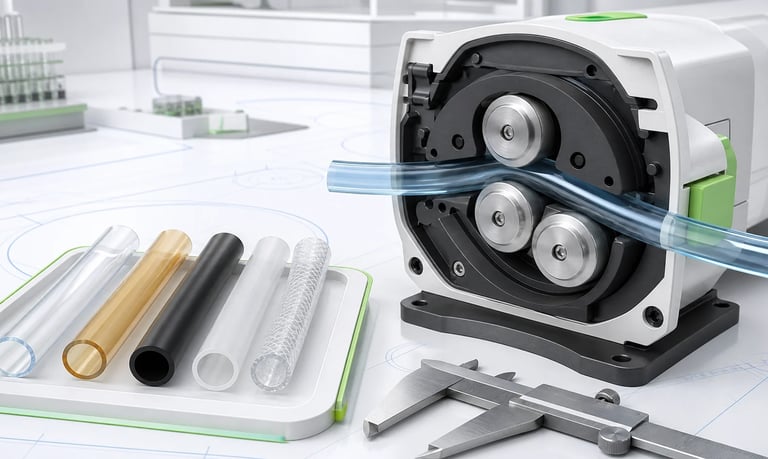
This practical guide explains how to select peristaltic pump tubing by comparing material compatibility, inner and outer diameter, wall thickness, hardness, flow, pressure, temperature, fatigue life, and maintenance requirements.
How to Choose Tubing for a Peristaltic Pump
Tubing is the pumping element and primary wetted component in a peristaltic pump. Rollers repeatedly compress it to move fluid, so the tube must satisfy chemical, mechanical, and dimensional requirements at the same time.
A material may resist the liquid during a static immersion test but fail quickly under repeated compression. A tube may have the right inner diameter but the wrong wall thickness for the pump head. Either problem can cause unstable flow, poor suction, excessive motor load, leakage, or premature wear.
Reliable selection therefore requires the actual fluid, pump head, operating point, duty cycle, and maintenance plan to be evaluated together.
Start with the Pump Head Specification
Do not select tubing from fluid compatibility alone. First identify the dimensions and material families approved for the pump head.
The pump head is designed around a particular outer diameter, wall thickness, hardness range, and compression track. Using a tube outside that range may prevent correct occlusion.
Ask the pump manufacturer for:
Approved tube dimensions
Recommended material options
Loading and retention method
Intended speed and pressure range
Tube replacement procedure
Available test data and limitations
Dimensional similarity does not guarantee equivalent performance. Manufacturing tolerances, surface finish, elasticity, and recovery can differ between tube suppliers.
Define the Fluid and Exposure Conditions
Prepare a complete fluid description before screening materials.
Chemical Identity and Concentration
Provide the exact chemical or formulation, including concentration. Include additives, solvents, preservatives, cleaning agents, and any fluid that may remain in the tube during storage.
Temperature
Record normal operating temperature, short cleaning temperature, ambient temperature, and storage conditions. Temperature can change viscosity, tube flexibility, chemical attack, and fatigue behavior.
Exposure Time
Continuous contact, intermittent dosing, and occasional flushing create different risks. A tube that performs acceptably during short transfer may swell or harden after long idle exposure.
Fluid Characteristics
Document viscosity, particles, abrasiveness, volatility, bubbles, oil content, and crystallization tendency. These characteristics affect flow, blockage risk, wear, and tube recovery.
Chemical compatibility should be verified under the actual concentration, temperature, pressure, and exposure time.
Understand Tubing Dimensions
Inner diameter, outer diameter, and wall thickness perform different functions.
Inner Diameter
Inner diameter strongly influences the volume moved per revolution. A larger bore generally provides more flow at the same speed, but it may require a larger pump head and more motor torque.
It also affects particle passage, fluid velocity, suction loss, and the minimum practical dose.
Outer Diameter
Outer diameter determines how the tube fits in the track, guides, clamps, and connectors. An incorrect outer diameter can allow tube movement or prevent the pump head from closing correctly.
Wall Thickness
Wall thickness affects occlusion, pressure resistance, recovery, suction, and fatigue. A wall that is too thin may not seal reliably or withstand pressure. A wall that is too thick may increase motor load and tube stress.
Use the complete dimensional specification rather than selecting by inner diameter alone.
Evaluate Hardness and Elastic Recovery
Peristaltic tubing must flatten under the rollers and recover afterward.
A softer tube may compress easily but can deform, creep, or move in the track. A harder tube may resist pressure but require greater occlusion force and motor torque.
Recovery is especially important for priming and inlet refill. If a tube remains flattened behind the roller, flow and suction can decline.
Hardness values from different standards or suppliers may not be directly comparable. Test the actual tube in the intended pump head.
Compare Common Tubing Material Families
Material names describe broad families, not guaranteed performance in every formulation.
Silicone Tubing
Silicone is flexible and commonly used for clean liquids, laboratory transfer, and general dosing. It is available in many sizes and can provide good pump-head handling.
Its suitability for oils, solvents, aggressive chemicals, pressure, and long service depends on the specific grade and conditions. It should not be treated as universally compatible.
Long-Life Thermoplastic Elastomer Tubing
Materials marketed for extended peristaltic life may offer improved fatigue resistance for some applications. Examples include PharMed-type and other thermoplastic elastomer formulations.
They may be useful when maintenance frequency matters, but chemical compatibility, temperature, extractables, cost, and pump-head fit still require review.
FKM-Based Tubing
FKM-based materials may be considered for selected oils, fuels, solvents, or chemicals. Their flexibility and fatigue behavior can differ from silicone or thermoplastic elastomers.
Compatibility and pump life must be tested with the exact formulation and operating conditions.
Special Chemical-Resistance Constructions
PTFE-lined, fluoroelastomer, composite, or other specialty constructions may be used for challenging fluids. Broad chemical resistance does not automatically mean good peristaltic flexibility or long fatigue life.
Layer bonding, bend radius, occlusion force, connector sealing, and recovery must be evaluated.
Match Tubing to Flow and Dose
Tubing size and motor speed determine the practical dosing range.
A large tube running for a very short time may provide poor resolution for a small dose. A small tube running at high speed may increase wear, inlet loss, and refill problems.
Select a combination that keeps typical operation within a stable middle range rather than relying only on the minimum or maximum speed.
Calibrate using the final tube, liquid, pressure, and control method. Nominal volume per revolution may change with compression, wear, temperature, and viscosity.
Consider Pressure and Suction
The tube must seal under the rollers and withstand the complete fluid system.
Back pressure from filters, nozzles, valves, narrow tubing, viscosity, and elevation can reduce flow and increase tube stress. Excessive pressure may cause tube movement, swelling, leakage, or motor overload.
On the inlet side, long or narrow tubing can prevent full refill. Tube recovery, suction height, liquid viscosity, and inlet leaks influence priming.
Confirm performance at the actual inlet and outlet conditions, not only at free flow.
Plan for Tubing Life
Tubing is a planned consumable. Its life depends on interacting factors:
Material and formulation
Tube dimensions and tolerances
Pump-head compression
Roller count and geometry
Motor speed
Back pressure
Fluid chemistry
Temperature
Continuous or intermittent duty
Installation and retention
Published life data may be useful for comparison only when test conditions are similar. Establish a replacement interval using representative life testing and an appropriate safety margin.
Check for Tube Creep and Walking
Repeated roller force can cause tubing to move through the pump head. This is often called tube creep or walking.
Movement may change compression, pull on fittings, alter flow, or damage the tube. Retention clamps, correct tube dimensions, suitable material friction, and proper loading can reduce the risk.
Inspect routing outside the head. Tight bends or tension from external tubing can also pull the pumping segment out of position.
Design Connections and Routing
The tube must connect securely without introducing excessive restriction or stress.
Use fittings that match the tube inner diameter, wall, hardness, and pressure. A fitting that stretches the tube excessively may cause cracking or stress relaxation. A loose fitting can leak or admit air.
Maintain a suitable bend radius, avoid sharp edges, support long tube runs, and keep the pumping segment free from torsion. Provide enough access for replacement without disturbing unrelated components.
Validate the Selected Tubing
A representative test should cover performance and durability.
Compatibility Test
Expose the tube to the actual fluid and cleaning agents. Check mass, dimensions, hardness, swelling, discoloration, cracking, tackiness, and loss of recovery.
Flow and Dosing Test
Measure initial flow, dose repeatability, priming, and pressure response. Repeat after warm-up and at relevant temperatures.
Life Test
Run the intended speed, pressure, fluid, and duty cycle. Monitor flow drift, tube movement, surface wear, flattening, leakage, current, and temperature.
Post-Test Inspection
Inspect the internal and external tube surfaces, roller contact area, fittings, and retention points. Record failure mode rather than only total run time.
Common Tubing Selection Mistakes
Selecting by inner diameter alone
Assuming every tube with the same material name performs identically
Using a compatibility chart without mechanical testing
Ignoring cleaning chemicals and idle exposure
Testing only with water at room temperature
Overlooking back pressure and suction loss
Running too fast for reliable tube refill
Failing to plan tube access and replacement
Using non-approved dimensions in the pump head
Treating tubing life as a guaranteed fixed value
Frequently Asked Questions
What is the best tubing for a peristaltic pump?
There is no universal best material. The correct tube must match the pump head, fluid, temperature, pressure, flow, duty cycle, maintenance target, and any applicable documentation requirements.
Can any flexible tubing be used?
No. General flexible tubing may lack the dimensional control, recovery, fatigue resistance, or hardness needed for repeated roller compression.
Does a larger inner diameter always provide better flow?
A larger bore usually increases displacement per revolution, but it may reduce dosing resolution, require more torque, or exceed the pump-head design. Select the size around the complete operating range.
Why does tubing flow change over time?
Repeated compression, temperature, pressure, chemical exposure, and material fatigue can change tube shape and recovery. Precision systems should include verification and recalibration.
How often should tubing be replaced?
Replacement intervals should be based on representative life tests, inspection results, application risk, and observed flow drift. A general material-based lifetime is not sufficient.
How should chemical compatibility be verified?
Screen published data, then test the exact tube with the actual chemical concentration, temperature, pressure, exposure time, pumping motion, and cleaning process.
Kamoer Tubing Selection Support
Peristaltic pump performance depends on the pump head and tubing working as one system. Correct material, dimensions, recovery, pressure capability, and service interval are essential for reliable dosing and transfer.
Kamoer develops micro and laboratory peristaltic pumps, diaphragm pumps, and customized OEM fluid-transfer solutions. Kamoer can help evaluate the fluid, tubing options, target flow, pressure, duty cycle, control method, installation, and validation plan.
Share your liquid, operating conditions, and maintenance requirements with Kamoer to begin a tubing and pump selection review.
Related Stories
Kamoer Fluid Tech (Shanghai) Co., Ltd.
pump@kamoer.com