

How to Choose a Pump for Viscous Liquids
PUMP SELECTION GUIDES
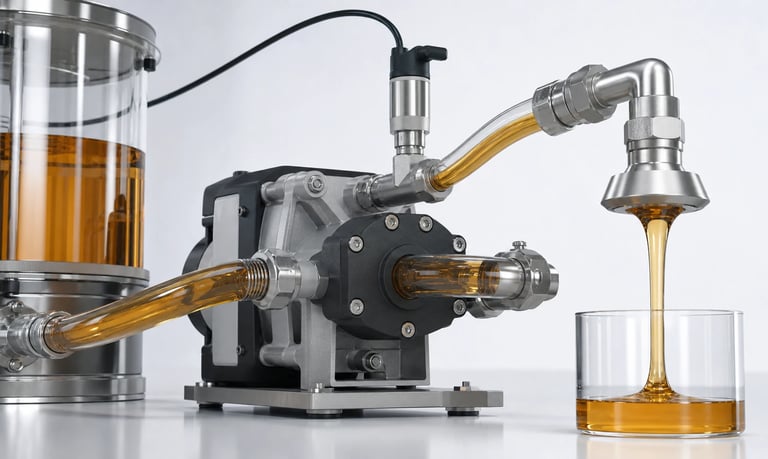
Reliable pumping of viscous liquids depends on a pump matched to the full viscosity and temperature range, required flow, inlet conditions, tubing and fitting resistance, pressure, shear sensitivity, wetted materials, priming, cleaning, and duty cycle.
How to Choose a Pump for Viscous Liquids
Viscous liquids resist flow more strongly than water. Syrups, oils, gels, adhesives, concentrated detergents, cosmetic formulations, reagents, and suspensions can create high inlet vacuum and outlet pressure in small tubing. They may also change viscosity with temperature, shear, storage time, or composition.
Choosing a pump for viscous liquids requires more than checking a nominal viscosity limit. The pump, inlet path, outlet path, control method, cleaning sequence, and final enclosure should be tested with the actual medium across its full operating range.
Define Viscosity Under Real Conditions
Viscosity should be specified with the temperature and measurement method. A value measured at room temperature may not represent cold startup, heated processing, or storage conditions.
Document:
Minimum, typical, and maximum temperature
Viscosity at each relevant temperature
Density and surface tension
Shear-rate dependence
Time-dependent thickening or thinning
Solids, fibers, crystals, or bubbles
Separation, settling, curing, or drying behavior
Some liquids are approximately Newtonian, meaning viscosity is relatively independent of shear rate. Others are shear-thinning, shear-thickening, thixotropic, or yield-stress materials. A single viscosity number may not describe their behavior inside valves, tubing, or a pump chamber.
Use representative rheological data and pump tests when fluid behavior is complex.
Define Flow and Dose Requirements
Specify minimum, typical, and maximum flow, allowed transfer time, dose range, duty cycle, and acceptable variation. Include startup, prime, purge, cleaning, and drain modes.
For intermittent dosing, calculate active flow from dose volume divided by available dispensing time. Avoid selecting a pump so large that the minimum dose becomes an extremely short command.
For continuous transfer, define the required flow at the maximum expected viscosity and system resistance. Do not rely on a free-flow rating measured with water.
Select the Pump Technology
Peristaltic Pumps
Peristaltic pumps keep the fluid inside replaceable tubing. They may handle compatible viscous liquids when tube size, speed, inlet conditions, pressure, and motor torque are suitable.
Advantages can include an isolated fluid path, self-priming, and reversible operation. Limitations include tube wear, pulsation, flow drift, inlet tube recovery, and pressure limits.
At high viscosity, the tube may not refill completely between roller passes, especially at high speed or high inlet vacuum. Increasing speed may therefore fail to produce a proportional increase in flow.
Diaphragm Liquid Pumps
Diaphragm pumps can provide compact transfer and pressure. Their internal valves and chamber must fill and empty during every cycle.
High viscosity can slow valve response, increase inlet loss, reduce flow, and raise motor load. Particles, fibers, sticky residue, or crystals may prevent valves from sealing.
Test the exact pump at the full viscosity and temperature range. A diaphragm pump suitable for water may not deliver the required viscous-liquid performance.
Gear, Piston, and Other Pumps
Gear, piston, progressive-cavity, syringe, or other technologies may be considered when viscosity, pressure, smooth flow, dose resolution, or continuous operation falls outside the practical range of available micro peristaltic or diaphragm pumps.
Selection must also account for shear, leakage, particles, sealing, cleaning, and wetted materials.
Design a Low-Resistance Inlet Path
The inlet side is often the limiting part of a viscous-fluid system. Excessive resistance can prevent full pump filling, cause unstable flow, draw air through fittings, collapse soft tubing, or contribute to cavitation where conditions allow vapor formation.
Improve inlet conditions by:
Keeping the inlet short
Using adequate internal diameter
Minimizing fittings, valves, and sharp bends
Placing the pump near or below the reservoir where appropriate
Using tubing that resists collapse under vacuum
Providing adequate reservoir venting
Avoiding unnecessarily fine inlet filtration
Measure inlet vacuum at the pump while operating at the coldest or highest-viscosity condition. Confirm that fittings remain airtight; an inlet leak may draw air without leaking liquid outward.
Calculate Outlet Pressure Loss
Pressure loss increases with viscosity, flow, tube length, and restrictive geometry. Small-diameter tubing, narrow fittings, check valves, filters, mixers, and nozzles can dominate the load.
Estimate resistance, then measure pressure and flow in the complete system. Include:
Minimum and maximum viscosity
Full tubing length and elevation
Clean and loaded filters
Open and partially restricted nozzles
All valves, sensors, and manifolds
Startup and steady conditions
Do not assume that pressure loss scales linearly if viscosity or flow behavior changes with shear or temperature.
Choose Tubing and Fittings
Larger tubing reduces pressure loss but increases internal volume, prime time, retained product, and cleaning waste. Select a diameter that balances flow, pressure, response, and fluid volume.
Avoid sudden contractions, dead pockets, and fittings with much smaller bores than the tubing. Use gradual transitions where possible.
Tubing must remain dimensionally stable under inlet vacuum and outlet pressure. For peristaltic pumps, it must also recover between compression cycles and maintain suitable mechanical properties during chemical and thermal exposure.
Verify material compatibility with production fluid, cleaner, rinse fluid, and mixed waste under actual conditions.
Manage Startup and Cold Conditions
A viscous liquid may require more torque and pressure to start moving than to continue flowing. After a long idle, it may cool, settle, cure, form a skin, or adhere to tubing and valves.
Test:
Coldest fluid and enclosure temperature
Longest expected idle period
Minimum supply voltage
Full and nearly empty reservoir
Dry and partially filled inlet path
Startup against residual outlet pressure
A soft-start profile may reduce electrical stress but may not provide enough initial torque. Conversely, an abrupt high-speed start can create pressure spikes. Develop the profile from system measurements.
Consider Shear and Product Quality
Pump mechanisms, valves, narrow gaps, high speed, and sharp restrictions can apply shear. This may change emulsions, polymers, cells, suspensions, foams, or shear-sensitive formulations.
Do not infer acceptable product quality from flow alone. Compare relevant properties before and after representative pumping, recirculation, and life exposure.
Lower speed, larger passages, a different pump technology, or reduced recirculation may help, but each change affects pressure, pulsation, size, and control.
Handle Particles and Suspensions
Particles, fibers, crystals, or suspended solids can increase apparent viscosity, settle in low-flow regions, abrade components, or obstruct valves and filters.
Define particle size, shape, hardness, concentration, settling rate, and whether the product may agglomerate. Keep the fluid path free of unnecessary dead legs and sharp contractions.
Filtration may protect the pump or nozzle but can remove desired material and add substantial pressure loss. Test clean and realistically loaded filters with the actual suspension.
Where settling is possible, evaluate agitation, recirculation, line orientation, startup discard, and idle procedures.
Control Bubbles and Priming
Air is compressible and can reduce dose accuracy or cause intermittent flow. Thick liquids may retain bubbles and release them slowly.
Use airtight inlet connections, controlled filling, suitable reservoir geometry, submerged pickup, degassing, bubble detection, or a prime timeout where appropriate.
Fast priming may increase pressure and aeration. Slow priming may not generate enough force to move cold fluid. Test the complete sequence with the actual product.
Manage Temperature Deliberately
Heating often reduces viscosity, but it also changes chemical compatibility, evaporation, product stability, tubing properties, and microbial or curing behavior. Never apply heat only to improve pump performance without reviewing the medium and equipment requirements.
If controlled temperature is part of the process, heat the relevant reservoir or path uniformly and monitor the liquid—not only ambient air. Avoid local hot spots near motors or heaters.
Validate warm cleaning cycles and cold restarts. Define safe limits and fault handling for failed temperature sensors or heaters.
Choose Control and Feedback
Fixed-speed operation may be adequate when viscosity, pressure, and temperature are stable. Variable speed can support prime, dispense, slow finish, and cleaning modes.
Timed control does not guarantee a fixed volume when viscosity or pressure changes. Closed-loop flow, weight, pressure, or level feedback may improve control where process requirements justify it.
Motor current can indicate changing load but does not directly measure flow. A blocked outlet, empty source, inlet leak, and cold fluid can produce different combinations of current, pressure, and flow.
Use maximum run-time, pressure, current, and temperature limits to prevent a failed sensor or blocked line from creating damage or an excessive dose.
Plan Cleaning and Idle Management
Viscous fluids can remain in dead volume and may dry, cure, separate, or support biological growth. Define whether the path is flushed, drained, kept filled, heated, or replaced after use.
Cleaning validation should cover fluid type, concentration, temperature, flow, contact time, direction, drainage, and verification method. The cleaner may be less viscous than the product and may not prove that all product residue was removed.
Design valves, fittings, sensors, and manifolds without pockets that cannot be reached by the cleaning flow. Make filters and consumable tubing accessible.
Build a Representative Test
Use production fluid or a validated representative with the same relevant rheology, particles, surface behavior, and compatibility. Test several fluid lots if variation is expected.
Record:
Flow or dose at multiple temperatures
Inlet vacuum and outlet pressure
Startup time and minimum reliable speed
Motor current and pump temperature
Prime time and bubble behavior
Pulsation and dose variation
Flow drift with aged tubing or valves
Cleaning effectiveness and restart
Water can support early setup checks but cannot establish final viscous-fluid performance.
Validation Checklist
Viscosity across the full temperature and shear range
Minimum, typical, and maximum flow or dose
Cold start and longest idle condition
Shortest practical inlet path and final production routing
Inlet vacuum and tubing collapse resistance
Outlet pressure with all components installed
Clean and loaded filters
Particles, settling, separation, and bubbles
Minimum and maximum supply voltage
Startup torque and control profile
Shear-sensitive product quality
Continuous, intermittent, and peak duty cycles
New and aged tubing, diaphragms, valves, and seals
Cleaning, drainage, storage, and restart
Blockage, inlet leak, empty source, and overpressure faults
Common Selection Mistakes
Using one viscosity value without temperature
Selecting from water and free-flow data
Restricting the inlet with small tubing or a fine filter
Increasing pump speed without checking inlet refill
Ignoring cold-start torque and residual pressure
Assuming current is a direct flow measurement
Overlooking shear effects on the product
Testing clean liquid without expected particles
Heating the fluid without reviewing stability and compatibility
Validating cleaning with rinse appearance alone
Frequently Asked Questions
Which pump is best for viscous liquids?
There is no universal best type. Peristaltic, diaphragm, gear, piston, and other pumps suit different viscosity, pressure, flow, shear, particle, and cleaning requirements.
Why does pump flow fall as viscosity increases?
Higher viscosity increases inlet and outlet resistance, slows chamber or tube refill, changes valve response, and raises required torque and pressure.
Can a peristaltic pump handle thick liquid?
It may when the tube, speed, inlet path, pressure, torque, temperature, and fluid compatibility are suitable. Validate tube refill and flow drift with the actual liquid.
Should viscous liquid be heated before pumping?
Only when the product and system allow controlled heating. Review stability, safety, evaporation, materials, cleaning, and temperature limits before using heat to reduce viscosity.
How should a viscous-liquid pump be tested?
Use the actual fluid and final fluid path across the full temperature, viscosity, pressure, voltage, duty, cleaning, and idle range while measuring flow, vacuum, pressure, current, and heat.
Kamoer Viscous-Liquid Pump Support
Kamoer can help evaluate viscosity, temperature, pump type, inlet conditions, tubing, pressure, materials, particles, control, cleaning, duty cycle, and OEM integration for viscous-liquid applications.
Related Stories
Kamoer Fluid Tech (Shanghai) Co., Ltd.
pump@kamoer.com