

How to Choose a Micro Pump for Liquid Dosing
MICRO PUMP BASICS
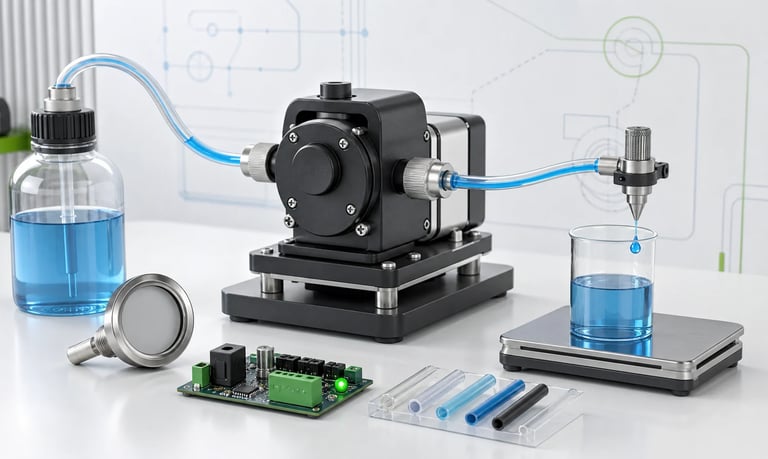
Choosing the right micro pump for liquid dosing is not only about flow rate. For OEM equipment manufacturers, the pump must also match the fluid, pressure condition, control method, installation space, duty cycle, and maintenance requirements.
How to Choose a Micro Pump for Liquid Dosing
Choosing the right micro pump for liquid dosing is not only about flow rate. For OEM equipment manufacturers, the pump must also match the fluid, pressure condition, control method, installation space, duty cycle, and maintenance requirements.
A suitable pump can improve dosing stability, reduce maintenance cost, and simplify equipment integration. An unsuitable pump may cause flow deviation, leakage, tubing wear, chemical compatibility issues, or unstable system performance.
This guide explains the key factors to consider when selecting a micro pump for liquid dosing applications.
1. Define the Dosing Application First
Before selecting a pump, clarify how the liquid will be used in the system.
Common liquid dosing applications include:
Reagent dosing in analytical instruments
Sample transfer in water quality monitoring equipment
Syrup or concentrate dosing in beverage machines
Detergent dosing in cleaning equipment
Nutrient or additive dosing in laboratory systems
Chemical dosing in environmental monitoring systems
Different applications have different priorities. For example, a laboratory dosing system may require stable low-flow performance, while a beverage machine may focus more on reliability, hygiene, and easy maintenance.
2. Confirm the Required Flow Rate
Flow rate is usually the first parameter customers consider. However, it should not be selected only by the maximum value.
You should confirm:
Minimum required flow rate
Maximum required flow rate
Typical working flow rate
Whether the pump runs continuously or intermittently
Whether calibration is required
Whether the liquid viscosity affects flow
For peristaltic pumps, flow rate is influenced by tubing size, motor speed, tubing compression, liquid viscosity, and back pressure. For diaphragm liquid pumps, flow performance is related to pump chamber design, valve structure, motor performance, and working pressure.
For precise dosing applications, it is recommended to test the pump under actual working conditions instead of relying only on theoretical flow data.
3. Check Pressure and Back Pressure
Back pressure is one of the most common reasons for incorrect pump selection.
In real systems, back pressure may come from:
Long tubing
Small inner diameter tubing
Filters
Check valves
Nozzles
Height difference
High-viscosity liquid
Downstream resistance
If back pressure is higher than the pump can handle, the system may experience reduced flow, unstable dosing, motor overload, tubing deformation, or leakage.
For small peristaltic pumps, pressure capability is usually limited by tubing material, pump head structure, motor torque, and tubing compression. Therefore, pressure requirements should be clearly confirmed before model selection.
4. Consider Liquid Compatibility
Material compatibility is critical for liquid dosing.
For peristaltic pumps, the liquid only contacts the tubing. This makes tubing selection especially important. Common tubing options include silicone, PharMed-type tubing, FKM, and other specialty materials.
For diaphragm liquid pumps, the liquid contacts internal wetted parts such as diaphragm, valve, pump chamber, and connectors. In this case, all wetted materials must be checked.
Important fluid information includes:
Chemical name
Concentration
Temperature
Viscosity
Solid content
Volatility
Corrosiveness
Whether crystallization may occur
Whether the liquid is food-related, medical-related, or industrial
Chemical compatibility should always be verified under actual concentration, temperature, pressure, and exposure time.
5. Choose the Right Pump Type
For liquid dosing, the two most common micro pump types are peristaltic pumps and diaphragm liquid pumps.
Peristaltic Pump
A peristaltic pump transfers liquid by compressing flexible tubing with rollers. The fluid only contacts the tubing.
Typical advantages:
Clean fluid path
Easy tubing replacement
Good for reagent dosing
Suitable for small and medium flow dosing
Can run dry in many cases
Good for applications where fluid isolation is important
Typical limitations:
Tubing is a consumable part
Flow pulsation may occur
Pressure capability is limited
Tubing compatibility must be checked
Diaphragm Liquid Pump
A diaphragm liquid pump transfers liquid through diaphragm movement and valves.
Typical advantages:
Compact structure
Suitable for OEM integration
Can provide stable liquid transfer in many equipment systems
No external pump tubing required in the pump head
Typical limitations:
Fluid contacts internal wetted parts
Valve performance may be affected by particles or crystallization
Material compatibility must be checked carefully
6. Select the Control Method
For OEM equipment, the control method is as important as mechanical performance.
Common control options include:
Fixed speed operation
PWM speed control
Analog signal control
RS485 or Modbus communication
External start/stop
Direction control
Feedback or closed-loop control
For simple dosing equipment, basic speed control may be enough. For analytical instruments, laboratory systems, or automated equipment, communication control and repeatability may be more important.
The control interface should match the equipment’s main control board and software design.
7. Evaluate Installation Space and Mechanical Integration
Micro pumps are often installed inside compact equipment. Therefore, the following factors should be checked:
Pump dimensions
Mounting hole position
Tubing direction
Connector type
Cable position
Heat dissipation
Noise and vibration
Maintenance access
For OEM manufacturers, a pump should not only meet performance requirements but also fit the final product structure.
8. Consider Maintenance and Service Life
Maintenance requirements depend on the pump type and application.
For peristaltic pumps, tubing is the main consumable part. Tubing life depends on speed, pressure, material, compression, duty cycle, and working environment.
For diaphragm pumps, maintenance may involve diaphragm, valve, or internal wetted parts depending on the operating conditions.
In systems that require frequent maintenance, tool-free tubing replacement or modular pump head design can reduce service time.
Common Selection Mistakes
Common mistakes include:
Selecting a pump only by maximum flow rate
Ignoring back pressure
Not checking chemical compatibility
Using theoretical data without real application testing
Ignoring tubing life
Choosing the wrong control method
Overlooking installation space
Assuming one pump can handle all liquids
A good pump selection process should consider the entire fluid path, not only the pump itself.
FAQ
1. Is a peristaltic pump good for liquid dosing?
Yes. Peristaltic pumps are widely used for liquid dosing because the fluid only contacts the tubing. They are suitable for many reagent, additive, and clean liquid transfer applications.
2. When should I choose a diaphragm liquid pump?
A diaphragm liquid pump is often suitable when compact structure, stable transfer, and internal pump integration are required. It is commonly used in OEM equipment.
3. Can one micro pump handle different liquids?
It depends on the pump structure and wetted materials. Chemical compatibility should be verified for each liquid under actual working conditions.
4. What affects dosing accuracy?
Dosing accuracy may be affected by tubing size, pump speed, viscosity, back pressure, calibration, motor control method, and system design.
5. How should I choose between different pump models?
Start with flow rate, pressure, fluid compatibility, control method, duty cycle, and installation space. Then test the selected pump under actual working conditions.
Kamoer Micro Pump Solutions
Kamoer provides micro peristaltic pumps, diaphragm liquid pumps, diaphragm gas pumps, and laboratory pump solutions for OEM equipment and fluid transfer systems.
For liquid dosing applications, Kamoer can help evaluate pump type, flow range, tubing or wetted material, control method, installation structure, and customization requirements.
Looking for a micro pump for your dosing system? Kamoer can support pump selection for OEM liquid transfer, reagent dosing, food and beverage equipment, laboratory instruments, and environmental monitoring systems.
Related Stories
Kamoer Fluid Tech (Shanghai) Co., Ltd.
pump@kamoer.com