

How to Calculate Pump Flow Rate for an OEM System
PUMP SELECTION GUIDES
Calculate continuous and dosing flow for an OEM pump system, convert common units, choose a practical operating margin, and validate performance under real fluid, pressure, tubing, and control conditions.
How to Calculate Pump Flow Rate for an OEM System
Pump flow rate is the volume of fluid delivered during a defined time. The basic calculation is simple, but selecting an OEM pump also requires pressure, viscosity, tubing, control, duty cycle, and calibration to be considered.
Basic Flow Formula
Flow rate = delivered volume / delivery time
If a pump transfers 600 mL in 2 minutes, average flow is 300 mL/min. Always state the unit and whether the value is measured, nominal, minimum, or maximum.
Calculate Flow for Dosing
For a single dose:
Required active flow = dose volume / allowed dosing time
A 10 mL dose delivered in 5 seconds requires 2 mL/s, or 120 mL/min, while the pump is running. Do not divide by the complete machine cycle if the pump operates only during part of it.
Common Unit Conversions
1 L = 1,000 mL
1 minute = 60 seconds
mL/s × 60 = mL/min
mL/min ÷ 1,000 = L/min
L/min × 60 = L/h
Keep extra precision during calculations, then round the final requirement appropriately.
Average vs Instantaneous Flow
Average flow describes delivery over a period. Peristaltic and diaphragm pumps produce pulsating instantaneous flow. A fast sensor may show peaks and valleys even when collected volume per minute is stable.
Define whether the application needs average transfer, smooth instantaneous flow, or a repeatable dose.
Include the Duty Cycle
Duty cycle is the fraction of time the pump runs.
Duty cycle = pump run time / total cycle time
A pump delivering 100 mL/min for 15 seconds in every minute has an average process delivery of 25 mL/min, but the pump must still provide 100 mL/min while running.
Account for the Operating Point
Catalog free-flow data may not represent installed performance. Actual flow changes with:
Inlet suction height
Outlet back pressure
Tube diameter and length
Filters, valves, sensors, and nozzles
Fluid viscosity and temperature
Pump speed and supply voltage
Tubing or valve wear
Select from flow at the required pressure or vacuum, then verify the assembled system.
Peristaltic Pump Estimation
An initial estimate may use:
Flow = volume per revolution × rotational speed
Actual volume per revolution depends on tubing dimensions, compression, recovery, viscosity, back pressure, temperature, and wear. Calibration is required for dosing accuracy.
Diaphragm Pump Estimation
An initial estimate may use chamber displacement multiplied by stroke frequency. Valve behavior, incomplete filling, bubbles, viscosity, and pressure reduce actual delivery, so performance curves and testing are more reliable than theoretical displacement alone.
Choose a Practical Margin
A pump needs enough capacity for manufacturing variation and worst operating conditions, but excessive oversizing can reduce low-flow control and dosing resolution.
Define minimum, typical, and maximum required flow. Choose a pump whose normal operating point lies inside a stable controllable range rather than at an extreme.
Measure Actual Flow
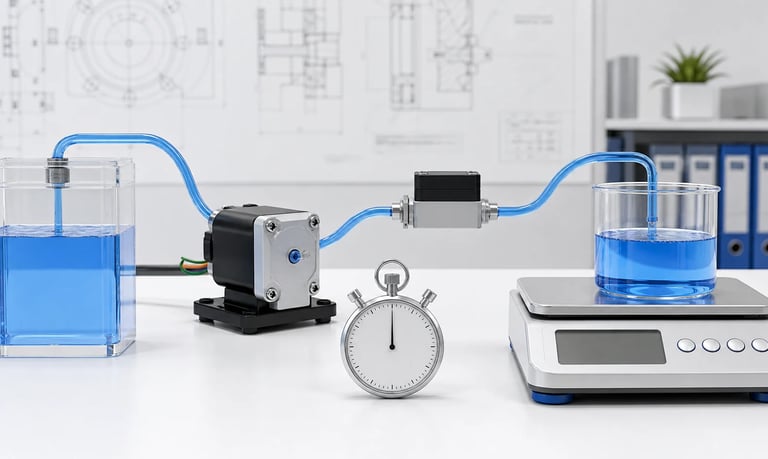
Assemble the final reservoir, tubing, fittings, filters, valves, and nozzle.
Use the actual liquid and expected temperature.
Prime the system and remove unintended bubbles.
Collect fluid for a measured time or number of doses.
Measure volume or mass using calibrated equipment.
Repeat several times and calculate average and variation.
Test pressure, temperature, speed, and liquid-level limits.
Repeat after representative wear or maintenance.
For mass measurement, convert to volume using the liquid density at the relevant temperature.
Common Mistakes
Confusing cycle-average flow with active pump flow
Mixing mL/s, mL/min, and L/h
Selecting from maximum free flow
Ignoring pressure and viscosity
Using theoretical displacement as guaranteed delivery
Measuring for too short a time
Testing only once
Calibrating with water instead of the real fluid
Adding an excessive margin that harms control resolution
Frequently Asked Questions
How long should flow be measured?
Use enough time or pump cycles to reduce timing and pulsation error while remaining representative of the application.
Does pump speed have a linear relationship with flow?
It may be approximately linear in part of the range, but viscosity, refill, pressure, motor behavior, and wear can create deviations.
Should I use mass or volume?
Either can work. Mass measurement is often convenient for small doses, but conversion to volume requires accurate density.
How much flow margin is needed?
Use a margin justified by variation and worst conditions. There is no universal percentage for every system.
Why is installed flow lower than catalog flow?
Catalog data may use different fluid, pressure, tubing, voltage, or temperature. Restrictions and viscosity commonly reduce installed flow.
Kamoer Application Support
Kamoer can help translate dose, timing, pressure, fluid, control, and duty-cycle requirements into a practical pump operating range and validation plan.
Related Stories
Kamoer Fluid Tech (Shanghai) Co., Ltd.
pump@kamoer.com