

How Temperature Affects Peristaltic Pump Tubing
TUBING & CHEMICAL
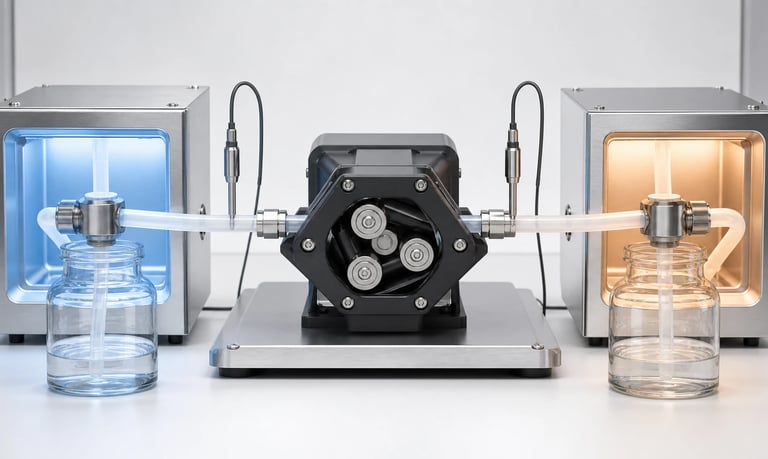
Peristaltic pump tubing performance changes with fluid, ambient, enclosure, cleaning, and storage temperature because temperature influences elasticity, recovery, dimensions, chemical exposure, permeability, pressure capability, flow calibration, and flex-fatigue life.
How Temperature Affects Peristaltic Pump Tubing
Temperature changes the mechanical and chemical behavior of peristaltic pump tubing. A tube can become softer, harder, slower to recover, more permeable, or less resistant to pressure as conditions change. The fluid itself may also become more or less viscous, adding another effect on pump flow.
A temperature limit in a tubing datasheet is not a complete pumping specification. OEM designers should evaluate the exact tube, pump head, fluid, pressure, speed, duty cycle, and cleaning process across the real operating range.
Identify Every Relevant Temperature
The tubing may experience several temperatures at once:
Fluid temperature
Ambient air temperature
Temperature inside the equipment enclosure
Pump-head and motor heat
Cleaning or sanitizing temperature
Sterilization temperature
Storage and transport temperature
Local heat from nearby electronics or heaters
Measure where the tube actually operates. Ambient temperature outside the enclosure may not represent the compressed section inside the pump head.
Include startup after cold storage, steady operation, hot cleaning, long idle periods, and repeated thermal cycles.
Temperature Changes Flexibility and Hardness
Elastomer and thermoplastic tubing properties vary with temperature. Lower temperature can reduce flexibility and increase the force required to compress the tube. Higher temperature can soften the tube and change how it supports pressure.
The amount of change depends on the exact material formulation, wall thickness, curing or manufacturing process, and exposure history.
Changes in hardness can affect:
Roller compression force
Motor current and torque
Occlusion and backflow
Tube recovery
Dose volume per revolution
Mechanical fatigue
Do not assume all silicone, thermoplastic elastomer, PharMed-family, or FKM grades respond the same way.
Tube Recovery Controls Refill
After a roller passes, the tube must reopen and draw in fluid. Recovery rate depends on elasticity, temperature, speed, inlet vacuum, fluid viscosity, and tube age.
At low temperature, a stiff tube may increase compression load or recover differently. At high temperature, a softened tube may recover slowly or remain partially flattened. Either condition can reduce flow and make speed-to-flow response nonlinear.
Test across the full speed range. If increasing speed no longer produces a proportional flow increase, incomplete tube refill may be one cause.
Fluid Viscosity Adds a Second Effect
Temperature often changes fluid viscosity. Many liquids become more viscous when cold and less viscous when warm, although complex fluids may behave differently.
Cold fluid increases inlet and outlet resistance. The combination of a stiffer tube and more viscous fluid can produce much larger flow loss than either effect alone.
Warm fluid may flow more easily but can increase chemical interaction, evaporation, permeation, or tube softening.
Separate tubing effects from fluid effects where possible, then validate them together in the complete system.
Flow Calibration Shifts with Temperature
Peristaltic flow depends on the volume trapped between rollers and how completely the tube fills. Temperature can change tube dimensions, elasticity, occlusion, slip, and fluid viscosity.
As a result, one calibration factor may not remain valid across the full temperature range.
Measure:
Flow at several pump speeds
Minimum and maximum temperature
Startup and stabilized operation
Minimum and maximum pressure
New and aged tubing
Individual doses and repeated series
If the process requires tighter control, use temperature-specific calibration, feedback, or a controlled fluid temperature. Avoid assuming a linear compensation without test data.
Pressure Capability Can Change
Higher temperature can reduce tubing strength, increase expansion, and weaken fitting retention. Lower temperature can reduce flexibility and increase cracking or connection stress for some formulations.
Pressure ratings may depend on tube dimensions, temperature, chemical exposure, duty cycle, and test method. A general maximum value may not apply inside a peristaltic pump where the tube is repeatedly compressed.
Test normal pressure, maximum expected restriction, blocked outlet, valve closure, and residual pressure at the temperature extremes. Include aged tubing and production fittings.
Occlusion May Need Review
Occlusion is the amount of tube compression between the roller and pump track. Too little occlusion can allow backflow or loss of prime. Too much can increase motor load, heat, and tube fatigue.
Temperature-driven changes in tube hardness and dimensions can alter effective occlusion. Adjustable pump heads should be set only within approved limits and verified across temperature.
Do not compensate for every flow change by increasing occlusion. Excess compression may shorten tube life or overload the motor.
Chemical Compatibility Is Temperature-Dependent
Chemical attack, swelling, extraction, and permeation can accelerate as temperature rises. A tube compatible during short room-temperature exposure may change during continuous warm pumping or hot cleaning.
Evaluate:
Exact fluid and concentration
Process temperature and duration
Cleaning and sanitizing agents
Pump speed and compression
Idle exposure while filled
Repeated thermal cycles
Inspect for swelling, hardening, softening, cracking, discoloration, tackiness, mass change, and loss of recovery.
Use supplier data for screening, then conduct dynamic pumping tests with the exact tubing grade.
Permeation and Evaporation Can Increase
Gas, vapor, or liquid components may pass through tubing walls. Temperature can change permeation rate and the vapor pressure of volatile fluids.
Possible consequences include:
Solvent or water loss
Concentration change
Oxygen or moisture ingress
Odor or vapor release
Bubble formation
Cross-contamination
Evaluate the complete tube length, wall thickness, enclosure ventilation, and idle duration. Chemical resistance does not automatically mean low permeability.
Flex-Fatigue Life May Change
Peristaltic tubing fails from combined mechanical cycling, chemical exposure, pressure, and temperature. Temperature can alter crack initiation, abrasion, permanent deformation, and elastic recovery.
Service life also depends on pump-head geometry, speed, occlusion, starts, direction changes, inlet vacuum, and outlet pressure.
Do not apply a room-temperature tube-life result across the full operating range. Test representative hot and cold conditions using multiple samples and track flow drift, motor current, temperature, particle generation, and visible damage.
Cleaning and Sterilization Need Separate Review
A short cleaning or sterilization exposure is different from continuous pumping at the same temperature. Steam, hot water, radiation, disinfectants, and repeated cycles can change tube dimensions and mechanical properties.
Define:
Method and temperature
Exposure and cooling time
Chemical concentration
Number of cycles
Whether the tube is installed in the pump head
Required post-process inspection
Recalibration requirement
Check the exact supplier documentation. Do not assume every grade in a material family supports the same process.
Thermal Cycling Affects Connections
Repeated heating and cooling can change tube dimensions, clamp force, compression set, and fitting retention. Different expansion rates between tubing and metal or plastic fittings may create leakage or loosening.
Test connections through representative thermal cycles under pressure and vacuum. Include chemical exposure, vibration, pull load, and aged tubing.
Define insertion depth, clamp position, fitting torque, and inspection criteria for production.
Manage Heat from the Pump and Enclosure
The motor, driver, nearby electronics, heaters, and limited ventilation can warm the tubing beyond the process-fluid temperature. Long continuous operation may create a local steady-state temperature not seen during short tests.
Measure the compressed tube section, pump head, motor, fluid inlet and outlet, and enclosure air until temperatures stabilize.
Use routing, spacing, ventilation, insulation, or controlled duty cycle as appropriate. Confirm that any cooling solution does not create condensation or draw contamination into the equipment.
Design the Temperature Test
Use the exact tubing grade, dimensions, pump head, fluid, fittings, pressure, speed, and control method.
At each relevant temperature, record:
Flow or dose
Inlet vacuum and outlet pressure
Motor current and speed
Tube and pump-head temperature
Prime time and bubble behavior
Tube recovery and visible flattening
Leakage and fitting retention
Flow drift with operating time
Allow the system to reach a defined stabilized condition before comparing results. Also capture transient behavior during cold start and warm-up.
Validation Checklist
Fluid, ambient, enclosure, cleaning, and storage temperatures
Exact tube grade and dimensions
Full pump speed and pressure range
Cold startup and hot steady operation
Fluid viscosity at each temperature
Flow and dose calibration shift
Tube recovery and inlet refill
Motor current and thermal stabilization
Occlusion and backflow
Pressure, blockage, and fitting retention
Chemical exposure and permeation
Cleaning or sterilization cycles
Thermal cycling and long idle exposure
Flex-fatigue life at representative extremes
New and aged tubing performance
Common Temperature Mistakes
Using room-temperature flow data for all conditions
Measuring ambient air instead of the tube inside the pump head
Treating a material's maximum temperature as a pumping rating
Ignoring fluid-viscosity change
Assuming one calibration factor works across temperature
Testing hot operation without hot chemical exposure
Applying short sterilization limits to continuous duty
Ignoring fitting retention during thermal cycles
Adjusting occlusion without checking motor load and tube life
Setting replacement intervals from one temperature condition
Frequently Asked Questions
Does peristaltic pump flow change with temperature?
Yes. Temperature can change tube dimensions, flexibility, recovery, occlusion, and fluid viscosity, all of which may affect flow.
Why does a peristaltic pump deliver less flow when cold?
The fluid may be more viscous, the tube may recover differently, and inlet resistance may increase. Test both the fluid and tube at the cold condition.
Can hot fluid shorten tubing life?
It may. Heat can change mechanical properties and accelerate chemical interaction. Life depends on the exact grade, fluid, pressure, speed, and duty cycle.
Is the tubing maximum temperature the same as the pump operating limit?
No. The system limit must also account for chemical exposure, cyclic compression, pressure, fittings, motor, pump head, and enclosure conditions.
Should a pump be recalibrated after sterilization?
Check the validated procedure. If sterilization changes tube dimensions or elasticity, inspection and recalibration may be required.
Kamoer Temperature and Tubing Support
Kamoer can help evaluate tubing grade, dimensions, pump-head fit, fluid temperature, flow calibration, pressure, occlusion, chemical exposure, cleaning cycles, and representative temperature-life testing.
Related Stories
Kamoer Fluid Tech (Shanghai) Co., Ltd.
pump@kamoer.com