

Can a Peristaltic Pump Run Dry
MICRO PUMP BASICS
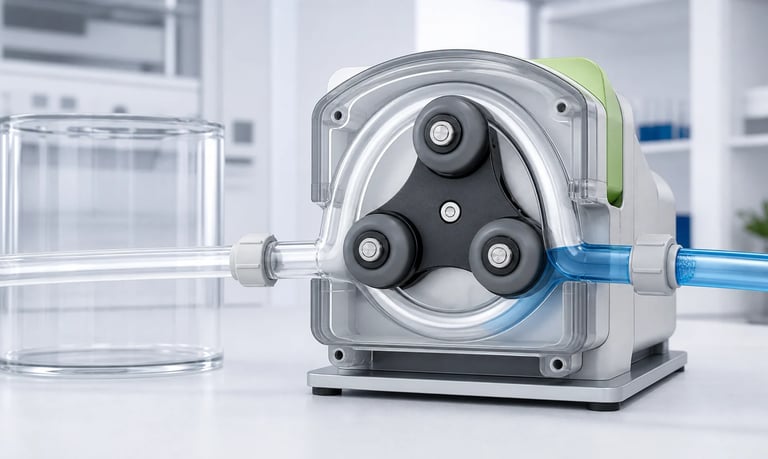
This article explains why many peristaltic pumps can move air and tolerate dry operation, why dry running still consumes tubing life, which operating factors affect risk, and how OEM systems should test and control empty-line operation.
Can a Peristaltic Pump Run Dry?
Many peristaltic pumps can operate with an empty tube because the pumped liquid does not lubricate internal valves, seals, or bearings. The rollers act on the outside of the tubing whether it contains liquid or air.
However, dry-running capability does not mean unlimited operation without consequences. The tube is still compressed during every revolution, so fatigue, heat, and mechanical wear continue even when no liquid is delivered.
What Dry Running Means
Dry running occurs when the pumping segment contains air instead of the intended liquid. It may happen during priming, after a reservoir empties, while purging a line, or because of an inlet leak or blockage.
Moving air briefly during a normal start-up is different from operating at high speed for hours after a reservoir becomes empty. The acceptable duration must be defined for the pump and application.
Why Peristaltic Pumps Can Move Air
Rollers close the flexible tube and move trapped volumes toward the outlet. Tube recovery behind a roller creates suction, so the pump can evacuate an inlet line and self-prime under suitable conditions.
There is no internal wetted valve that must remain submerged. This gives peristaltic pumps an advantage in systems that start with empty tubing or require air purging.
What Happens to the Tubing
Dry tubing still experiences:
Repeated compression and bending
Friction and local heating
Fatigue at the roller contact zone
Gradual flattening and loss of recovery
Stress from excessive occlusion
Movement or walking through the pump head
Liquid can change heat transfer and tube behavior, so dry and wet life may differ. The direction of that difference depends on material, fluid, speed, pressure, and pump-head design.
Factors That Set the Safe Limit
Tubing Material and Size
Material formulation, wall thickness, hardness, elasticity, and fatigue resistance affect heat generation and life. Use tubing approved for the pump head.
Speed
Higher speed creates more compression cycles per minute and may increase temperature. Reduce speed during priming or purge when the process allows.
Occlusion
Excessive compression increases motor torque, friction, and tube stress. Use the specified pump-head setting and tube dimensions.
Duty Cycle
A short dry start followed by liquid transfer is different from repeated long empty-reservoir events. Test the worst expected operating sequence.
Temperature
Ambient heat, enclosure heat, motor temperature, and tube friction can combine. Tube stiffness and fatigue behavior may change at temperature extremes.
Back Pressure
Air flow through a blocked or highly restricted outlet can still load the motor and tube. Dry running should not be confused with safe blocked-outlet operation.
Risks Beyond Tubing Wear
Dry operation may indicate an empty reservoir, disconnected inlet, leak, clogged filter, or failed process. Even if the pump survives, the equipment may deliver an incorrect dose, introduce bubbles, lose calibration, or allow a process to continue without liquid.
OEM equipment should treat dry running as both a mechanical and process-control condition.
How to Detect an Empty Line
Possible methods include:
Reservoir level sensing
Bubble or liquid detection in the tube
Flow sensing
Pump current or load monitoring
Weight measurement
Pressure or vacuum monitoring
Maximum priming-time software limits
No single method fits every fluid. Validate detection with bubbles, foam, transparent and opaque liquids, and expected temperature conditions.
How to Test Dry-Running Capability
Install approved new tubing correctly.
Record initial flow, current, temperature, and tube condition.
Run the intended dry speed and duration.
Repeat the expected dry/wet cycle sequence.
Monitor pump head, motor, driver, and tube temperature.
Restore liquid and measure priming time, flow, and dosing repeatability.
Inspect for flattening, cracks, abrasion, discoloration, and tube movement.
Repeat with representative aged tubing and ambient temperature.
Use results to set software timeouts, maintenance intervals, and fault responses.
Design Recommendations
Limit dry speed and duration to validated conditions.
Stop the pump when an empty reservoir is detected.
Provide a controlled priming and purge routine.
Avoid excessive occlusion and outlet restriction.
Recalibrate if prolonged dry running changes tube performance.
Record dry-run faults for maintenance review.
Replace tubing after abnormal heat, damage, or uncertain exposure.
Frequently Asked Questions
Can a peristaltic pump run dry continuously?
Some models may tolerate extended dry operation, but continuous suitability depends on tubing, speed, temperature, occlusion, and duty cycle. Confirm and validate the specific configuration.
Does dry running damage the motor?
The motor still drives tube compression. Excessive occlusion, speed, heat, or a blocked outlet can increase load even without liquid.
Can dry running help prime the pump?
Yes. The pump normally moves air from an empty inlet line before liquid arrives. Priming ability depends on tube recovery, sealing, suction height, and restrictions.
Should the pump stop when the reservoir is empty?
Usually this is good process protection, even if the pump tolerates air. It prevents missed dosing and unnecessary tube wear.
Does running dry extend tubing life?
Not necessarily. Compression fatigue continues, and frictional heat may change. Life must be established through representative testing.
Kamoer Application Support
Kamoer can help evaluate tubing, speed, priming, dry-run duration, sensing, duty cycle, and maintenance requirements for micro and laboratory peristaltic pump systems.
Related Stories
Kamoer Fluid Tech (Shanghai) Co., Ltd.
pump@kamoer.com